Stop and call for qualified help when plumbing water is near electrical equipment, sewage is entering occupied space, gas or burning odors are present, or a repair would require opening pressurized piping.
You notice that the hot water takes longer to recover after a shower, and the heater has started making a low rumbling sound whenever it runs. Then you find a rusty streak below one of the pipe connections. If you are deciding whether to repair or replace a water heater in Pretty Bayou, do not assume that every symptom means the tank has failed. Some problems involve replaceable parts, while others indicate that the heater is no longer dependable.
Keep the area clear. If water is spreading, steam is present, the tank appears swollen, or you smell gas, stop using the heater and call for prompt help. Do not touch wet wiring, remove access covers, or attempt to patch the tank. If the cold-water shutoff is dry and safely accessible, it may be closed to slow an active leak.
Why a Water Heater Can Lose Performance Gradually
Water heaters often decline in stages. Recovery time may increase, noises may become noticeable, and usable hot water may decrease. These changes can result from sediment, a failing element, a thermostat problem, a worn burner component, or reduced tank capacity.
Common Problems That May Be Repairable
Sediment Buildup
Minerals and debris can settle at the bottom of a tank-style heater. The buildup may trap water and create popping or rumbling sounds during heating. It can also reduce usable tank volume and slow heat transfer.
Failed Heating Elements or Thermostats
Electric water heaters commonly use upper and lower heating elements. When one fails, the heater may produce limited hot water or recover slowly. A faulty thermostat can cause lukewarm water, overheating, or inconsistent performance.
These parts may be replaceable if the tank and wiring remain serviceable.
Ignition, Burner, or Gas-Control Problems
A gas heater may struggle because of a failed igniter, flame sensor, burner component, gas control, or venting issue. Some conditions can be repaired, but gas and combustion systems require qualified diagnosis.
Leaking Connections and Valves
Rust streaks or moisture near the top may come from a fitting, connector, valve, or nearby pipe. Those sources can often be corrected without replacing the entire unit.
When Replacement Becomes the More Responsible Choice
A confirmed leak through the tank body is the clearest reason for replacement. The tank stores hot water under pressure. Once corrosion creates an opening, exterior sealants, epoxy, tape, clamps, or screws cannot safely restore it.
Replacement may also make sense when several major parts are failing, repairs have become frequent, the unit cannot meet normal demand, or replacement parts are unavailable.
Age is one factor, not the only factor.
Safe Checks a Homeowner Can Perform
Check whether every hot-water fixture has the same problem. If only one faucet or shower is affected, the issue may be a fixture cartridge or mixing valve rather than the heater.
Note how long the hot water lasts, how long recovery takes, and whether noise occurs only during heating. Without touching equipment, look for moisture around visible connections, valves, the relief-valve pipe, and the base. Photograph the model and serial number.
If an electric heater trips the breaker more than once, leave it off. Repeated resetting can worsen an electrical fault.
What You Should Not Attempt
- Do not remove electrical access panels, test live terminals, replace elements, or bypass safety controls unless qualified.
- Never cap or plug the temperature-and-pressure relief valve. It releases excessive temperature or pressure.
- Do not patch a leaking tank. Even if an improvised repair slows the drip, the underlying metal may continue to weaken.
- For gas equipment, do not alter the burner, pilot assembly, gas valve, draft hood, vent, or combustion-air opening.
- Do not aggressively flush an older, corroded heater before its condition is evaluated. Disturbing hardened sediment may expose a weak point.
Signs That Make the Problem Urgent
A rapidly expanding leak, water near electrical equipment, steam, a bulging tank, or dangerously hot water requires prompt attention.
Repeated discharge from the relief valve can indicate high pressure, thermal expansion, overheating, or a defective valve. Thermal expansion occurs when water increases in volume as it heats. In a closed system, that increased volume must be controlled.
Gas odor, soot, scorch marks, delayed ignition, an unstable flame, or damaged venting are also urgent. If you smell gas, leave the area and contact the appropriate emergency or gas service from a safe location.
How a Licensed Plumber Diagnoses the Heater
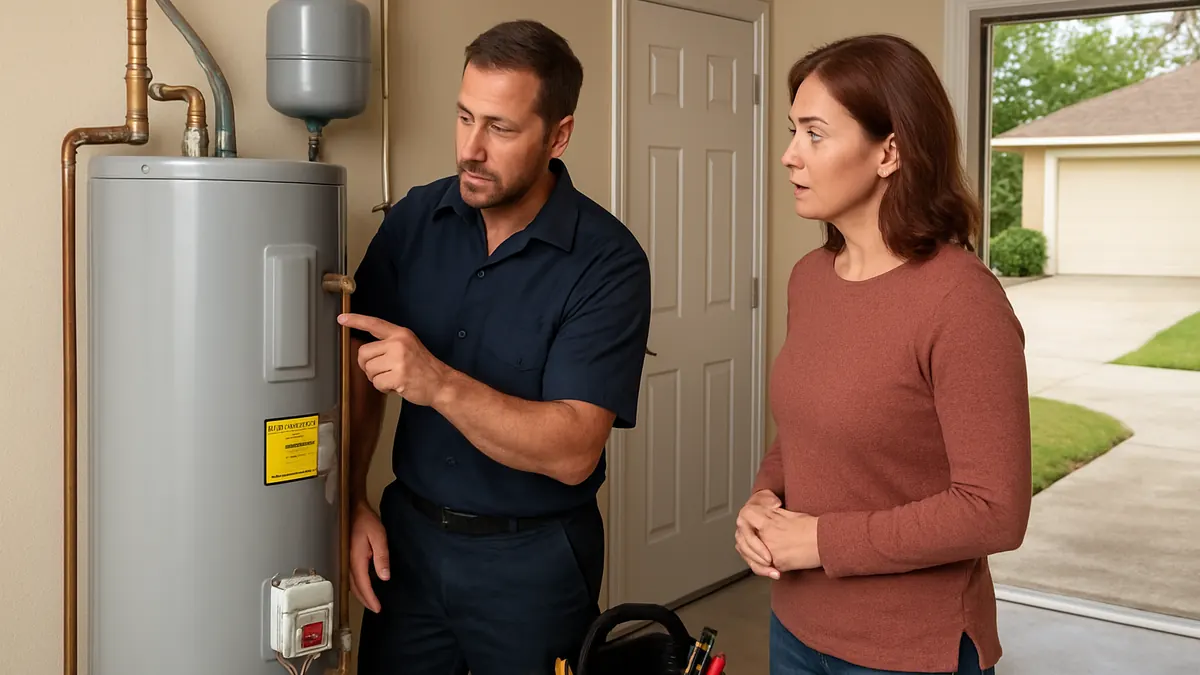
A plumber reviews the symptoms, heater type, fuel source, age, capacity, installation, and repair history. The leak source is traced instead of assumed.
For an electric heater, testing may include voltage, element resistance, thermostats, safety controls, and wiring. For a gas heater, diagnosis may include ignition, burner operation, gas control, combustion air, and venting.
The plumber may also check water pressure, temperature, the relief valve, and thermal expansion system. If hot water runs out too quickly, actual capacity and recovery are compared with household demand.
Repair Options From Least Invasive to Most Extensive
The smallest repair may involve correcting a setting, replacing an approved connection, replacing a connector, or addressing a fixture-specific problem.
Component repair may include a thermostat, heating element, igniter, burner component, drain valve, relief valve, anode rod, or expansion tank. The cause behind a failed safety device must also be corrected.
Professional flushing may be considered when sediment is confirmed and the tank remains suitable for service.
More extensive corrections can include pressure regulation, thermal expansion control, venting, electrical work, drainage protection, or piping changes.
Replacement is generally recommended when the tank leaks, corrosion is advanced, failures recur, or the heater no longer meets demand. A properly sized tank-style heater may be the most direct solution. Tankless equipment may also be evaluated when fuel or electrical capacity, venting, usage, and maintenance expectations make it practical.
Typical Factors That Affect Cost
Repair cost depends on the failed component, heater type, access, diagnostic time, parts availability, and required plumbing, electrical, gas, or venting corrections.
Replacement cost is affected by capacity, efficiency, fuel type, location, removal, connection changes, drainage protection, thermal expansion control, venting, permits, and required upgrades.
Prevention and Maintenance Guidance
- Inspect around the heater periodically for moisture, rust streaks, unusual sounds, or slower recovery. Keep the unit accessible and avoid storing items against it.
- Ask whether flushing is appropriate for the model and condition. Periodic anode-rod inspection may help slow internal corrosion.
- Have water pressure and thermal expansion checked if valves drip repeatedly. Keep gas-heater combustion and vent areas clear.
Repair or Replace a Water Heater in Pretty Bayou: Make the Decision From the Evidence
When deciding whether to repair or replace a water heater in Pretty Bayou, focus on the source of the problem, tank integrity, repair history, safety, and household demand. A sound tank with one replaceable component may be a strong repair candidate. A leaking pressure vessel, severe corrosion, repeated failures, or inadequate capacity usually points toward replacement.
A proper diagnosis helps you avoid both unnecessary replacement and repeated spending on an unreliable heater.
About this guide: This resource provides general homeowner education, not a remote diagnosis. Actual conditions, code requirements, equipment, and safe repair options must be evaluated at the property.