Stop and call for qualified help when plumbing water is near electrical equipment, sewage is entering occupied space, gas or burning odors are present, or a repair would require opening pressurized piping.
The first shower is hot, the second turns cold, and recovery takes much longer than usual. You may reset the breaker once, only to have the problem return. For a Callaway homeowner, this raises the question: should the water heater be repaired, or is replacement the better use of the service call?
Stop using the unit if it is leaking rapidly, producing steam, giving off a gas odor, or sending water toward electrical equipment. Do not repeatedly reset a tripped breaker or relight a gas unit that will not stay operating. A single failed part may be repairable, but repeated shutdowns require diagnosis.
The Three Questions That Guide the Decision
A plumber usually begins with three questions:
- Is the tank itself sound?
- Can the failed part be replaced safely?
- Will the repair provide reasonable reliability?
If the tank is sound, repair may be sensible. If it has failed, corrosion is widespread, or several major problems exist, replacement is more practical.
The purpose of diagnosis is to avoid spending money on a repair that cannot solve the underlying problem.
Common Causes of Limited or Unreliable Hot Water
Electric element or thermostat failure
An electric water heater usually has upper and lower heating elements. When one fails, the unit may produce a small amount of hot water or recover slowly. A faulty thermostat can also create lukewarm water, overheating, or inconsistent operation. Repeatedly resetting the high-limit switch without finding the cause is not a repair.
Gas ignition or combustion trouble
A gas heater may stop heating because of the igniter, flame sensor, gas control, burner, or venting. These conditions require testing rather than guesswork.
Sediment and reduced capacity
Sediment can reduce usable capacity, cause rumbling, slow recovery, and add stress. Severe buildup combined with corrosion can change the recommendation.
Demand greater than capacity
The heater may be operating correctly but unable to keep up with longer showers, added occupants, large tubs, or simultaneous hot-water use. Replacing a working component will not correct insufficient capacity.
Clues That Favor Repair
- Repair deserves consideration when the leak is from an accessible connection rather than the tank, the failed part is replaceable, and the unit has not had repeated major problems.
- Examples include a defective thermostat, one failed element, a repairable ignition component, a worn drain valve, a leaking connector, or a failed expansion tank.
- Repair is especially reasonable when testing identifies one clear fault and the tank shows no active leakage or severe deterioration.
Clues That Favor Replacement
Water emerging from the tank shell or beneath the insulated jacket usually indicates tank failure. Because the tank holds water under pressure, patching the exterior is not an acceptable long-term solution.
Replacement may also make sense when several components are deteriorated, parts are unavailable, repairs keep recurring, or the installation needs extensive correction.
Age provides context but is not a verdict. Condition and repair value matter more than the date alone.
Safe Checks Before the Appointment
Confirm whether all hot-water fixtures have the same problem. A single faucet with low temperature may have a mixing-valve or cartridge problem.
Record when the shortage occurs, how many fixtures were used, and how long recovery takes. Check for moisture without touching wiring or opening covers. Look at top connections, valves, and the floor around the base.
Do not keep resetting a tripped breaker. Repeated trips can indicate a failed element, damaged wiring, moisture, or another electrical fault.
Repairs Homeowners Should Avoid
- Do not remove electrical covers or test energized terminals without proper training and equipment.
- Do not replace a dripping relief valve before the cause is evaluated. The valve may be responding to excessive temperature, high pressure, or uncontrolled thermal expansion.
- Do not modify a gas line, burner, vent, draft hood, or combustion-air path. A heater that lights is not necessarily venting safely.
- Never attempt to seal a leaking tank with epoxy, a clamp, a screw, or an automotive product. Even if the drip slows, the metal can continue weakening.
When the Problem Needs Immediate Attention
Treat a gas odor as urgent. Leave the area, avoid switches or flames, and contact the appropriate emergency or gas service from a safe location.
Prompt help is also needed for a rapidly growing leak, water contacting electrical components, steam, unusually hot tap water, a bulging tank, recurring relief-valve discharge, soot, scorch marks, or a disconnected vent.
If the tank is leaking and the shutoff valve is safe to reach, close the cold-water supply. For an electric heater, turn off the dedicated breaker only when the panel and surrounding area are dry.
How a Licensed Plumber Reaches a Recommendation
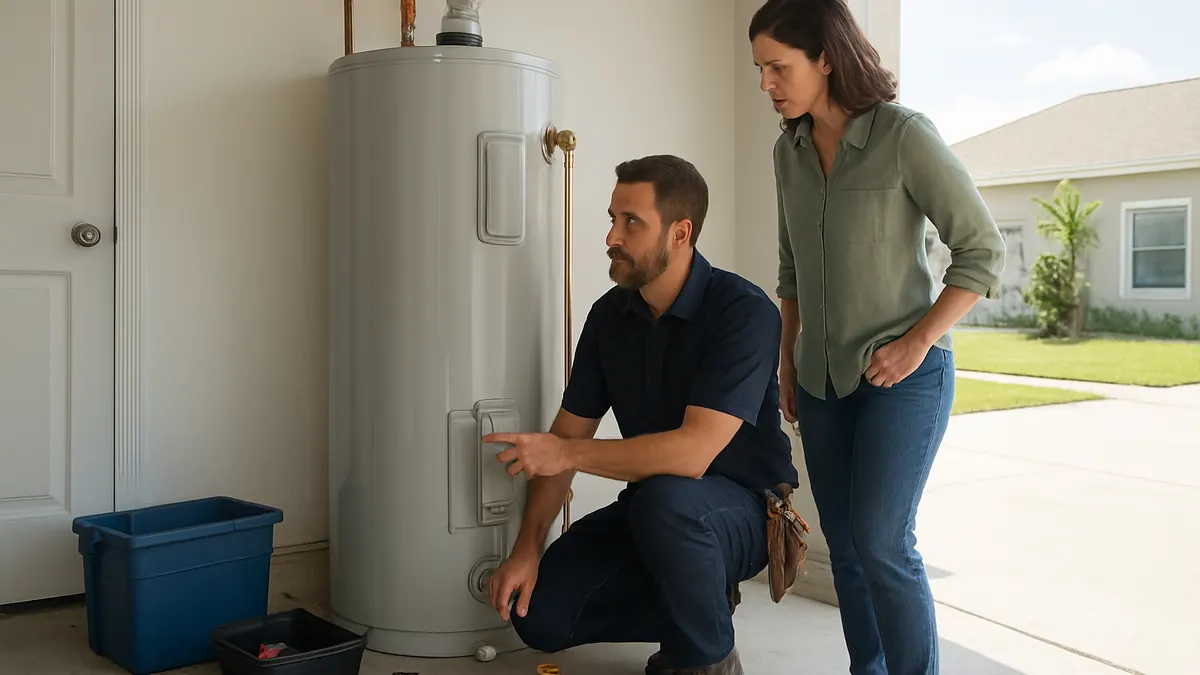
The plumber identifies the model, fuel type, capacity, age, and installation condition. Testing may cover power, elements, thermostats, ignition, burner condition, venting, temperature, pressure, and leak location.
The relief valve and thermal expansion tank may also be inspected because they protect the system as heated water expands.
After testing, the plumber separates the immediate failure from the broader condition. Replacing an element may restore heat, but active tank leakage would make that repair poor value. Conversely, a sound tank should not be discarded simply because one replaceable control failed.
Repair and Replacement Options
The least invasive solution may be correcting a setting, repairing an accessible connection, replacing a connector, or fixing a fixture problem that only appeared to involve the heater.
Component repair may include an element, thermostat, ignition part, burner component, valve, anode rod, or approved control. Flushing may be discussed when sediment affects performance and the tank is suitable for service.
System corrections may include pressure regulation, thermal expansion control, drain-pan improvements, vent correction, or piping changes.
When replacement is justified, the new unit should be sized for actual demand. A tank-style heater may be the most direct choice. A tankless unit may be considered when fuel or electrical capacity, venting, usage, and maintenance expectations support it. Tankless is an option, not an automatic upgrade for every home.
What Affects the Cost?
Repair cost is influenced by the component involved, access, fuel type, part availability, diagnostic time, and related safety corrections.
Replacement cost depends on equipment capacity and efficiency, installation location, connection changes, venting, gas or electrical requirements, permits, removal, drainage protection, and expansion control.
Ask whether repair addresses one isolated fault, whether other failures appear likely, and what replacement modifications are required.
Maintenance That Can Extend Service
Inspect periodically for dampness, rust trails, unusual noises, or changes in recovery time. Keep stored items away from the unit and keep gas-heater combustion openings clear.
Ask a plumber whether flushing is appropriate for the heater's design and condition. Have pressure and expansion control checked when relief valves drip. Periodic anode-rod evaluation may help protect the tank from internal corrosion.
Changes in sound, temperature, recovery, or moisture are reasons to schedule an inspection.
Repair or Replace a Water Heater in Callaway?
To repair or replace a water heater in Callaway, first determine whether the failure is isolated or whether the tank and installation are deteriorating together. Repair makes sense when one serviceable part has failed and the remaining system is sound. Replacement is usually the responsible choice when the tank leaks, reliability is poor, or extensive corrections are required.
A measured diagnosis prevents unnecessary replacement and repeated repairs to an unreliable system.
About this guide: This resource provides general homeowner education, not a remote diagnosis. Actual conditions, code requirements, equipment, and safe repair options must be evaluated at the property.