Stop and call for qualified help when plumbing water is near electrical equipment, sewage is entering occupied space, gas or burning odors are present, or a repair would require opening pressurized piping.
You turn on the shower and the water is only lukewarm. Later, you notice a puddle near the water heater or hear popping sounds while it runs. If you live in Bid-A-Wee and are deciding whether to repair or replace a water heater, keep people and belongings away and look for active leaking. Shut off the water or power only if you can do so without entering a wet area or handling damaged equipment.
A failed element, thermostat, valve, or connection may be repairable. A leaking tank, severe corrosion, repeated breakdowns, or an unsafe installation may favor replacement. The decision should be based on the failure and whether repair will restore dependable service.
What the Symptoms May Mean
Water that never gets fully hot may indicate a failed electric heating element, faulty thermostat, gas burner problem, ignition issue, or incorrect setting. Hot water that runs out quickly may result from sediment buildup, one failed element, a damaged dip tube, increased demand, or an undersized tank.
Popping or rumbling often occurs when sediment collects at the tank bottom. Rust-colored hot water may point to corrosion, a deteriorated anode rod, or rust in the piping.
Moisture around the unit can come from a loose fitting, supply line, drain valve, temperature-and-pressure relief valve, or the tank itself. An external connection may be repaired. A tank leaking through its metal shell generally cannot.
Common Problems That May Be Worth Repairing
Heating-system failures
An electric heater may have a failed element or thermostat, leaving the home with limited hot water or slow recovery. A gas model may have an ignition, burner, gas-control, or safety-control problem. Proper testing can identify whether a replaceable component is responsible.
Leaking valves or connections
A plumber may be able to replace a leaking supply connector, drain valve, relief valve, or approved fitting. Water can travel down the outside of the tank, so a leak near the bottom does not always mean the tank has failed.
Sediment-related performance loss
Sediment can reduce usable capacity, create noise, and slow heat transfer. Professional flushing may help some units, but disturbing hardened sediment in an older, corroded tank can expose an existing weak point. The tank should be evaluated first.
When Replacement Usually Makes More Sense
An active leak from the tank body is the strongest reason to replace a tank-style water heater. The tank is a sealed pressure vessel. Once corrosion creates a hole, exterior patching does not provide a safe or durable repair.
Age alone should not decide the issue. Replacement becomes more reasonable when age is combined with corrosion, poor recovery, repeated service calls, or unavailable parts.
Replacement may also be appropriate when the unit is undersized, has unsafe venting, cannot be corrected economically, or no longer provides reliable hot water.
Safe Checks a Homeowner Can Perform
Check whether the problem affects every fixture. If only one shower is lukewarm while other faucets are hot, the shower valve may be the issue.
Notice how long the hot water lasts and whether the problem appears only during heavy use. Use a flashlight without removing panels to see whether moisture begins at a pipe, fitting, valve, relief-valve tube, or beneath the jacket. Write down the model and serial number for age and parts research.
If you smell gas, hear hissing, see scorching, find water near wiring, or observe a rapidly spreading leak, leave the area and call for help.
What You Should Not Attempt
- Do not remove electrical panels, test live wiring, bypass a control, or replace an element unless qualified. Electric water heaters operate on high voltage.
- Never plug or cap the temperature-and-pressure relief valve. It is designed to release excessive temperature or pressure.
- Do not use sealant, screws, epoxy, or an improvised patch on a leaking tank. These methods cannot restore the tank's structural integrity.
- For a gas unit, do not alter the burner, gas valve, vent connector, combustion-air openings, or exhaust system. Incorrect work can create fire or carbon-monoxide hazards.
Signs the Problem Is Urgent
Prompt service is needed when water is spreading across the floor, leaking near electrical components, or coming from the tank body. Shut off the water only if the valve is safely accessible.
Other urgent signs include steam, extremely hot water, repeated relief-valve discharge, a bulging tank, soot near a gas burner, a disconnected vent, or the smell of gas. Leaking, overheating, gas odor, and unsafe venting may create property or safety risks.
How a Licensed Plumber Diagnoses the Unit
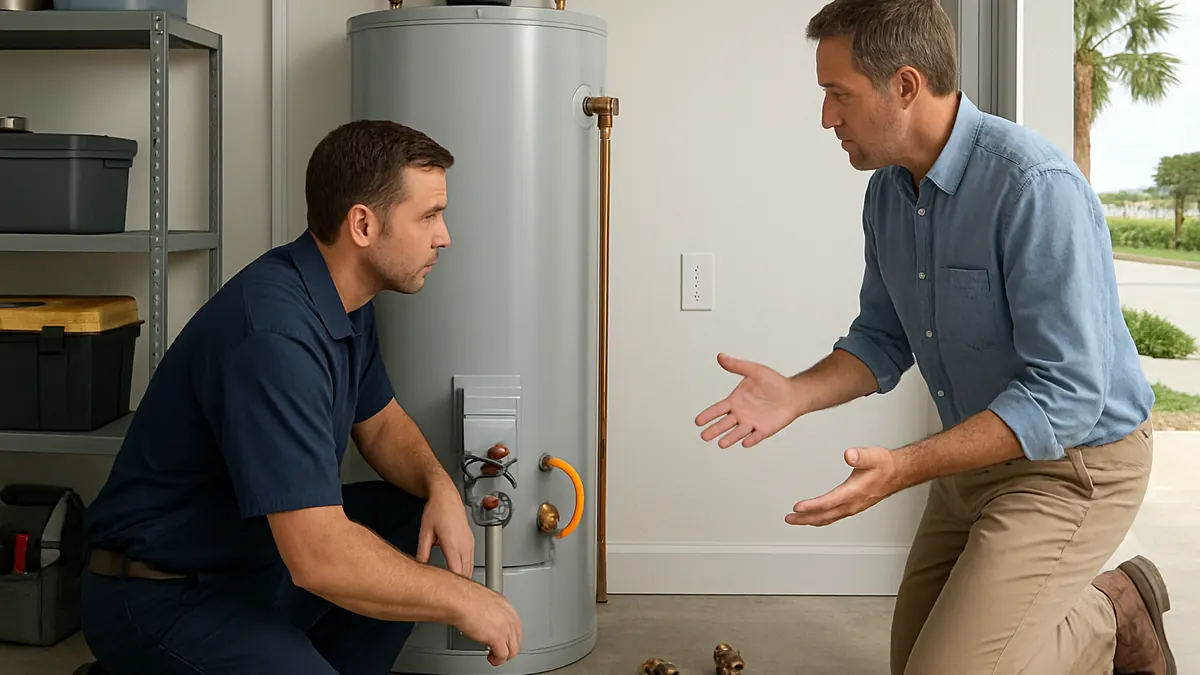
A plumber identifies the heater type, age, capacity, symptoms, and installation condition. The inspection may include leak tracing, temperature testing, electrical checks, thermostat and element testing, burner or ignition inspection, vent evaluation, and relief-valve inspection.
The plumber may also check water pressure and thermal expansion. In a closed system, heated water needs room to expand; otherwise, pressure can damage valves, fittings, and the heater.
The goal is to determine whether repairing one part will return the entire system to safe, dependable operation.
Repair Options, Beginning With the Least Invasive
The least invasive solution may be correcting a setting, replacing a supply connector, tightening an approved connection, or repairing a nearby pipe.
The next level may involve replacing a thermostat, heating element, ignition component, drain valve, relief valve, anode rod, or gas control. Professional flushing may be considered when sediment is contributing to noise or reduced capacity and the tank is suitable for service.
More extensive work can include correcting venting, damaged piping, expansion control, or drain-pan protection.
Complete replacement is recommended when the tank leaks, major corrosion is present, repair reliability is doubtful, or the unit no longer meets household demand. Options may include another tank-style heater or, where appropriate, a tankless system. Fuel supply, electrical capacity, venting, maintenance, and hot-water demand should be reviewed before changing system types.
Factors That Affect Cost
Repair cost depends on the failed part, heater type, part availability, access, labor, and whether related electrical, gas, plumbing, venting, or safety corrections are needed.
Replacement cost is affected by capacity, efficiency, fuel type, location, removal of the old unit, drain-pan needs, expansion control, venting, permits, and connection modifications.
A low repair cost is not good value if another major failure is likely soon. Replacement is also not necessary when one serviceable part has failed. A useful estimate should explain the problem, proposed work, and expected reliability.
Prevention and Maintenance
Keep the area around the heater clear and inspect occasionally for moisture, rust streaks, or unusual sounds. Do not block combustion-air openings around a gas model.
Ask whether periodic flushing is appropriate for the specific heater and its condition. Have water pressure and thermal expansion evaluated if valves drip repeatedly. Anode-rod inspection may also help slow internal corrosion.
Early attention matters. A small external leak may be repairable today but can damage flooring or nearby belongings if ignored.
Repair or Replace a Water Heater in Bid-A-Wee: The Next Step
When deciding whether to repair or replace a water heater in Bid-A-Wee, focus on the actual failure, tank condition, likely repair reliability, and household needs. A minor component or external connection may justify repair. A leaking tank, severe corrosion, repeated failures, or an unsuitable system usually points toward replacement.
Do not decide based only on age or the location of a puddle. A proper diagnosis can show whether a targeted repair will solve the problem or merely delay replacement.
About this guide: This resource provides general homeowner education, not a remote diagnosis. Actual conditions, code requirements, equipment, and safe repair options must be evaluated at the property.