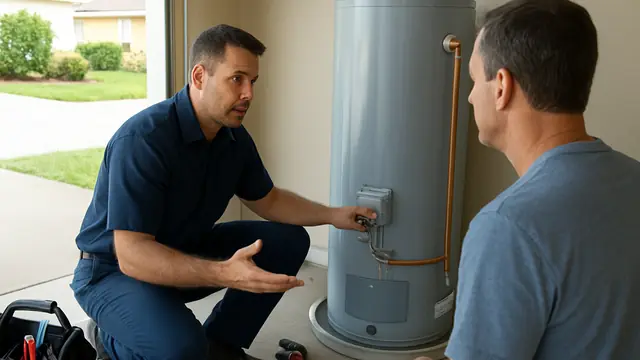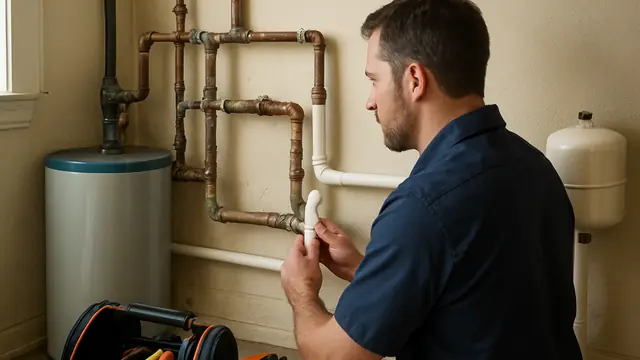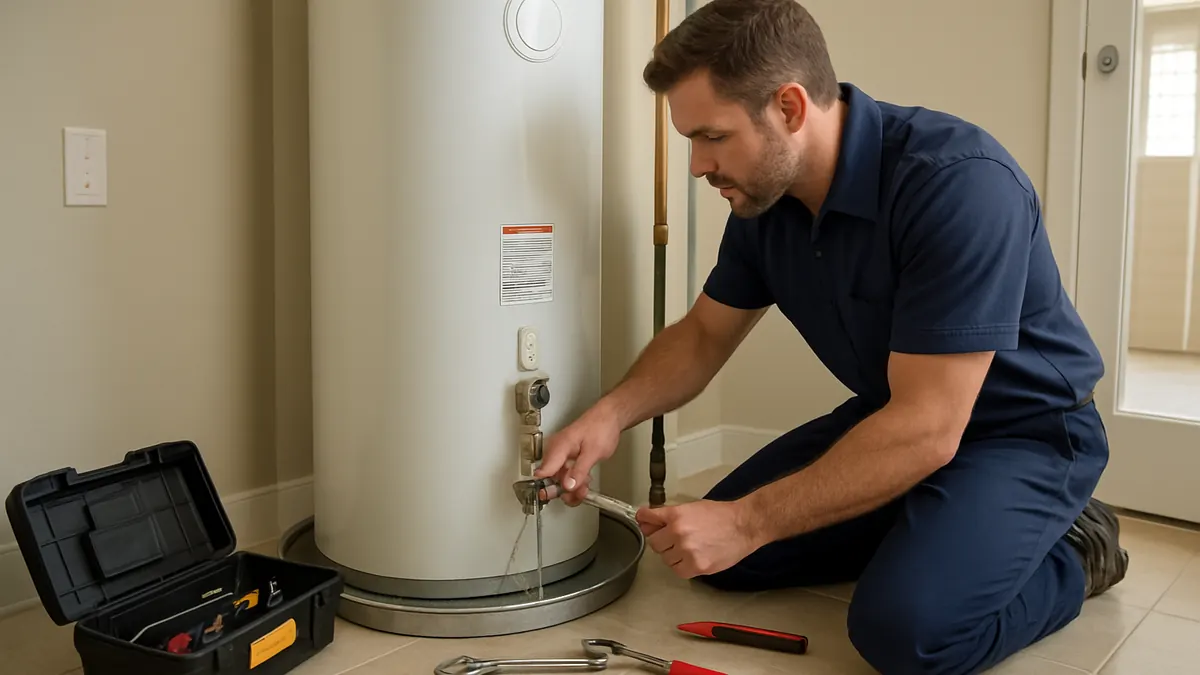
Stop and call for qualified help when plumbing water is near electrical equipment, sewage is entering occupied space, gas or burning odors are present, or a repair would require opening pressurized piping.
A water heater leak may appear as a wet utility-room floor, a pan that keeps refilling, or water staining near a closet. You may also hear the heater refill when nobody is using hot water. In an intermittently occupied property, the first warning may come from a guest, property check, or water alarm.
If your water heater is leaking in Sandestin, stop using hot water and determine whether water is still moving. Keep people away from the wet area. If the cold-water shutoff can be reached from a dry surface, close it. Do not touch electrical equipment while water is present. If the heater uses gas and you smell gas, leave the building and contact the gas utility or emergency services.
Do not assume that water underneath the heater automatically means the tank has ruptured. Leaks from top connections, relief valves, drain valves, nearby piping, or condensation can all collect in the same place.
Why Is My Water Heater Leaking in Sandestin?
A Pressurized Connection Is Seeping
The cold inlet and hot outlet remain under plumbing-system pressure. Their connectors, threaded fittings, unions, and shutoff valves can leak when seals deteriorate, joints loosen, or corrosion damages the metal.
The Temperature and Pressure Relief Valve Is Opening
The temperature and pressure relief valve, called the T&P valve, protects the heater from excessive temperature or pressure.
If the valve drips repeatedly, the valve itself may be worn. The discharge may also indicate high incoming water pressure, a thermostat problem, or thermal expansion. Thermal expansion is the increase in water volume that occurs as water heats. In a closed plumbing system, that increased volume must be controlled.
A plumber needs to test the system before deciding that replacing the valve alone will solve the problem.
The Drain Valve Is Not Sealing
The drain valve near the tank bottom allows the heater to be emptied or flushed. It may leak from the outlet, the valve stem, or its threaded tank connection.
Sometimes debris prevents the valve from closing completely. In other cases, the valve body or seal has deteriorated.
The Inner Storage Tank Has Failed
Tank-style water heaters use a steel vessel protected by an internal lining and an anode rod. As the lining and anode protection deteriorate, corrosion can attack the steel.
Water emerging from beneath the jacket, around a seam, or through an area with extensive rust may indicate that the inner tank has perforated. A leaking tank shell generally cannot be repaired reliably and requires replacement.
The Heater May Not Be the Source
A nearby pipe, drain, appliance connection, or water-treatment component may leak into the pan. The water must be traced before a repair decision is made.
Safe Checks for the Homeowner
Inspect from a dry area with a flashlight, but do not remove panels or insulation. Check the top connections, shutoff, visible piping, T&P discharge pipe, drain valve, and pan for droplets, mineral crust, rust, or water trails.
When safe, dry visible surfaces and place a paper towel below a suspected fitting. Note whether moisture returns while the heater is idle or reheating, and whether water temperature, duration, color, or sound has changed.
What You Should Not Attempt
- Do not cap or plug the T&P discharge pipe. The valve must be free to release pressure.
- Do not loosen a component on a hot, full, or pressurized tank. Escaping water can cause burns.
- Do not open an electric access cover while power is on. Do not stand in water to operate a disconnect or breaker.
- Do not adjust gas controls, disconnect a gas line, or alter the vent system.
- Do not force a stuck shutoff valve. If corrosion has weakened it, the valve may break and turn a small leak into uncontrolled water flow.
- Do not cover a tank leak with epoxy, tape, or putty. An external patch does not repair the corroded steel vessel.
Signs That Require Urgent Attention
Treat the problem as urgent when water is flowing faster, the local shutoff does not work, or moisture is entering walls, flooring, cabinets, ceilings, or another unit.
Repeated discharge of very hot water from the relief pipe needs prompt evaluation. Steam, scalding water, a bulging tank, electrical arcing, burning odors, or a loud impact sound followed by leakage are serious warnings.
If you smell gas, leave the area without operating switches or using a phone inside. Contact the gas utility or emergency services from a safe location.
Even a slow leak needs timely attention when the property may be unoccupied. The longer water flows, the greater the chance of concealed damage.
How a Licensed Plumber Diagnoses the Leak
A licensed plumber controls water or energy when needed and dries the heater so fresh moisture can be traced. The inspection covers connectors, pipe joints, valves, the pan, and tank jacket.
The plumber may test water pressure and check the regulator or expansion tank. Electric components or gas burner and venting conditions may also be evaluated after the equipment is made safe. The goal is to distinguish a repairable component failure from an internal tank leak.
Repair Options From the Least Disruptive Forward
A threaded-joint leak may be corrected by proper tightening or resealing. A failed connector, union, shutoff, drain valve, or electric-element gasket may be replaceable when the tank remains sound.
A leaking T&P valve can be replaced after the plumber checks temperature, incoming pressure, and thermal expansion. Pressure-regulator or expansion-tank service may be necessary when system conditions caused the valve to discharge.
If the inner tank has failed, replacement is normally the reliable option. A homeowner may consider another storage heater, a higher-efficiency tank, a heat-pump model where suitable, or a properly sized tankless system. Equipment selection should account for available space, hot-water demand, fuel or electrical capacity, venting, and access for future service.
Factors That Affect the Cost
Cost depends on the source, heater type and capacity, accessibility, venting, gas or electrical work, pressure controls, drain-pan condition, and piping changes. Repairs to water-damaged finishes are separate from correcting the plumbing leak.
Prevention and Maintenance
- Inspect the heater and drain pan regularly. Look for moisture, mineral deposits, corrosion, and signs that the relief valve has discharged.
- Keep the shutoff valve and service area clear. Have water pressure checked when fixture cartridges, appliance hoses, connectors, or valves fail repeatedly.
- Ask whether flushing, anode-rod evaluation, or expansion-tank service is appropriate for the heater's type and condition.
- For intermittently occupied properties, a leak alarm or professionally installed automatic shutoff system can provide earlier warning and may reduce the amount of water released.
Identify the Source Before the Leak Reaches Another Area
If you are asking, "Why is my water heater leaking in Sandestin?" the next step is to determine whether the water comes from a serviceable fitting, a pressure problem, or the tank itself. Prompt diagnosis is especially important when water can travel into finished areas or remain unnoticed. A licensed plumber can begin with the least invasive reasonable repair and recommend replacement only when the tank or overall equipment condition makes it necessary.
About this guide: This resource provides general homeowner education, not a remote diagnosis. Actual conditions, code requirements, equipment, and safe repair options must be evaluated at the property.