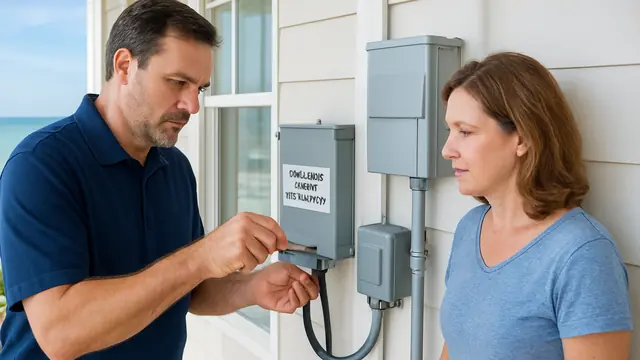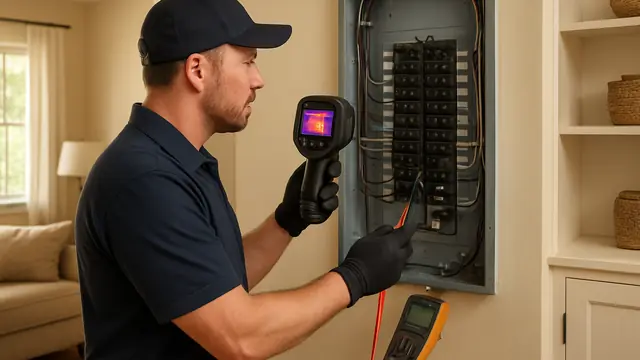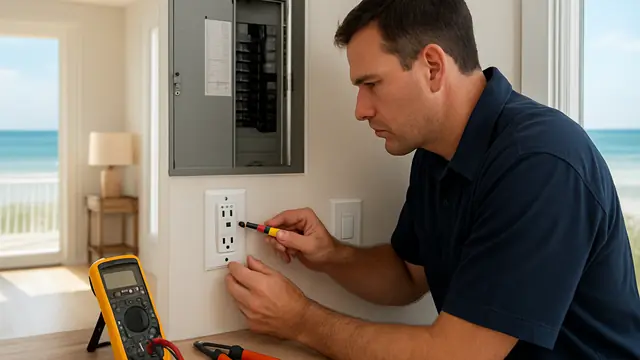
Do not remove an electrical panel cover, touch exposed conductors, bypass protection, or repeatedly reset a fault. Keep clear of smoke, sparks, burning odors, hot equipment, standing water near electricity, and downed lines, then call qualified help.
You finish using a vacuum, countertop appliance, or outdoor tool, and several outlets suddenly go dead. You find the GFCI, press RESET, and the button refuses to stay in. In a Blue Mountain Beach residence or vacation property, that can interrupt a bathroom, kitchen, garage, porch, or exterior circuit.
Unplug every device connected to the dead outlets. Do not touch a wet receptacle, remove a cover, or keep pressing RESET. Check the breaker once if the panel is dry and undamaged. If the GFCI still will not reset, leave it off because a shock hazard may remain.
A GFCI Can Protect More Than One Outlet
One GFCI can protect standard receptacles connected to its LOAD terminals. Those outlets may be in the same room, another room, a garage, or outside.
The problem may be somewhere other than the outlet you are pressing. A wet exterior receptacle, damaged appliance cord, loose connection, or pinched cable downstream can trip a GFCI located indoors.
Why Won't My GFCI Outlet Reset in Blue Mountain Beach?
The GFCI Has No Incoming Power
Most GFCI receptacles will not latch without power. A breaker may have tripped, another GFCI may be upstream, or a loose connection may have interrupted the circuit.
A tripped breaker can be hard to spot because its handle may move only slightly. Move the suspected breaker fully to OFF, then ON. If it trips again, stop.
An Appliance Is Creating a Ground Fault
A ground fault occurs when current leaves its intended path. This can happen inside a hair dryer, toaster, refrigerator, washing machine, power tool, extension cord, or lighting transformer.
Damaged insulation, moisture, or a pinched cord can allow current to escape even when the appliance appears to work.
Water or Corrosion Is Inside the Circuit
Exterior equipment can be affected by rain, cleaning water, condensation, a damaged cover, or water following a cable into a box. Corrosion and debris may continue conducting current after the surface looks dry.
The GFCI may also protect another device that is not obvious. Waiting and resetting does not correct the entry point.
The Outlet Has Failed
A GFCI contains electronic parts, contacts, and a trip mechanism. These can deteriorate from age, heat, repeated trips, surges, loose terminals, or corrosion.
Some devices perform automatic internal tests. When protection fails, the reset function may lock out. That safety feature should never be bypassed.
The Circuit Has a Wiring Problem
A loose neutral, shared neutral, crossed conductor, or improper splice can create unusual current paths. The neutral normally carries current back toward the electrical source.
Incorrect LINE and LOAD wiring can also prevent resetting or proper downstream protection. Connections must be identified with the circuit de-energized and tested rather than guessed from wire color.
Safe Troubleshooting Steps
Unplug every item from the affected GFCI and all receptacles that lost power at the same time. Power strips and extension cords count even when connected equipment is switched off.
Press RESET once with dry hands. If it holds, reconnect equipment one item at a time. Stop using any item that causes another trip or has a damaged cord, burning odor, or signs of moisture.
- Look for additional GFCIs in bathrooms, kitchens, garages, laundry areas, and exterior locations. Reset only dry, intact devices.
- Check the breaker once. If it trips again, leave it off.
- Visually inspect outlet covers and plugs. Cracks, rust, warmth, discoloration, loose mounting, or an exterior cover that will not close are reasons to stop.
What a Homeowner Should Not Attempt
- Do not tape, wedge, or hold RESET in. Do not replace the GFCI with a normal receptacle to stop the trips.
- Do not pull the outlet from the wall while it may be energized. Boxes can contain multiple cables, and an incorrect breaker label can create a false sense of safety.
- Do not spray cleaner into the receptacle or use heat to dry it.
- Avoid moving conductors between LINE and LOAD or combining neutral wires without testing. A change that restores power may silently remove protection elsewhere.
Warning Signs That Require Urgent Attention
- Turn the breaker off when safe if the receptacle is hot, discolored, melted, buzzing, crackling, smoking, or producing a burnt odor.
- Keep everyone away if water has entered an electrical box or appliance. Do not touch equipment while standing on a wet surface.
- A shock or tingling sensation should never be dismissed. Stop using the circuit and arrange prompt inspection. The same applies when both the breaker and GFCI trip repeatedly.
How a Licensed Electrician Diagnoses the Problem
The electrician confirms that the breaker supplies voltage and that the GFCI receives power on its LINE terminals. Grounding and neutral paths are checked for loose connections and improper sharing.
If the device has incoming power, its trip and reset function are tested. A failed GFCI can then be separated from a fault elsewhere.
When downstream wiring is involved, the LOAD conductors may be disconnected. If the GFCI resets with them removed, the electrician traces the protected outlets and divides the circuit into sections. This can isolate a wet box, damaged receptacle, defective appliance, or cable fault without replacing everything.
Testing may include voltage, polarity, insulation-resistance, and leakage-current measurements.
Repair Options in a Sensible Order
The simplest outcome may be removing a faulty appliance. An electrician may also correct a loose terminal, reset an upstream device, or repair a damaged cover that allowed moisture entry.
If the GFCI has failed, replacing that device may solve the problem. The new outlet must be connected correctly and tested at every downstream receptacle it protects.
When one downstream box is damaged, the repair may be limited to replacing a receptacle, removing corrosion, correcting a splice, or repairing a short cable section. A dedicated circuit may be appropriate when the existing arrangement is unsuitable.
Broader rewiring is considered only when there is widespread deterioration, unsafe modifications, or damage that cannot be corrected reliably with limited repairs.
Factors That Influence Cost
A visible failed GFCI in an accessible box is simpler to diagnose than a fault that appears only during rain or after equipment operates for several minutes.
Cost can be affected by the number of downstream outlets, finished-surface access, exterior box damage, corrosion, panel issues, attic or crawlspace access, mislabeled circuits, appliance testing, and cable-tracing time.
The repair should match the evidence. Ask what failed and why the work is necessary.
Prevention and Maintenance Guidance
Test each GFCI monthly. Press TEST to confirm power shuts off, then press RESET. If the device does not trip or restore power correctly, schedule service.
Keep exterior covers closed and in good condition. Use cords rated for their environment and keep plug connections away from standing water.
Replace damaged cords instead of wrapping them with tape. Avoid running several high-demand devices from one outlet. Have recurring trips investigated while the pattern is easy to describe.
Resolve the Cause Before Restoring Power
When you are wondering, "Why won't my GFCI outlet reset in Blue Mountain Beach?" remember that the outlet may be keeping a real hazard from being energized. Unplug equipment, perform only dry and visible checks, and avoid repeated resets. A licensed electrician can determine whether the failure is in the GFCI, an appliance, downstream wiring, a connection, or moisture-affected equipment and begin with the least invasive safe repair.
About this guide: This resource provides general homeowner education, not a remote diagnosis. Actual conditions, code requirements, equipment, and safe repair options must be evaluated at the property.