Stop and call for qualified help when plumbing water is near electrical equipment, sewage is entering occupied space, gas or burning odors are present, or a repair would require opening pressurized piping.
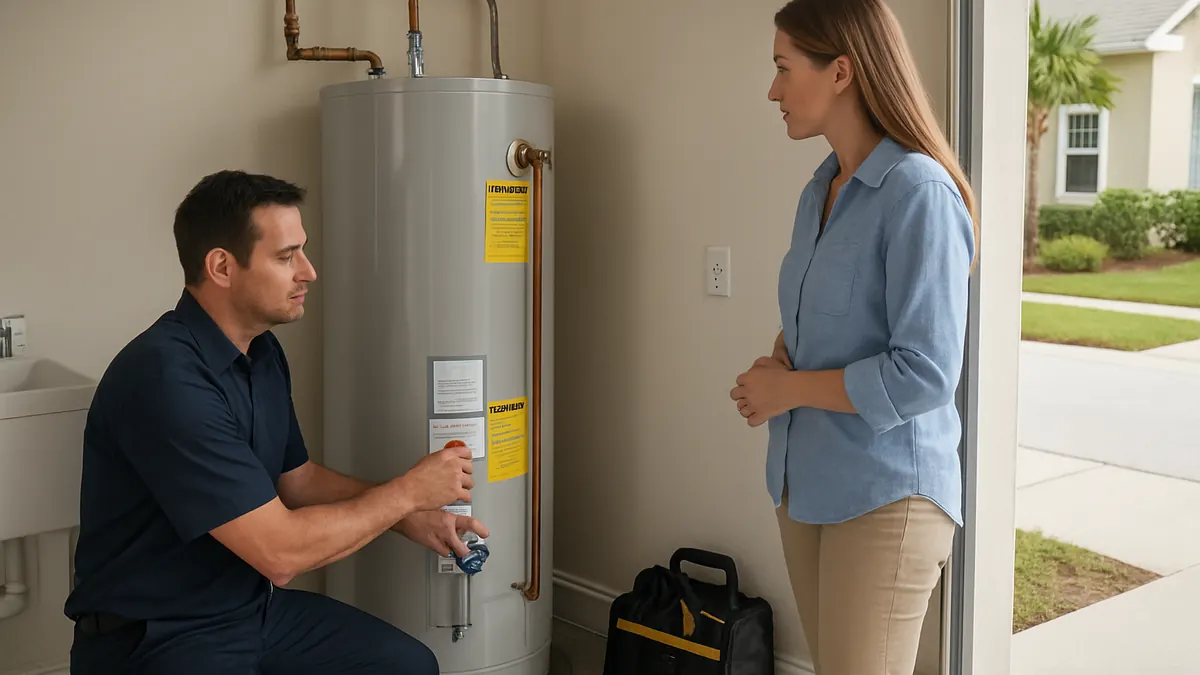
You wake up to a cold shower and find the water-heater breaker tripped. After one reset, the heater works briefly and shuts down again. For a Lynn Haven homeowner, that pattern may indicate a failed element, damaged wiring, a thermostat problem, or moisture inside the unit.
Leave the breaker off if it trips again. Do not remove access panels or touch wiring. If the unit leaks, produces steam, smells burned, or overheats the water, stop using it and request prompt service. The repair-or-replace decision should begin with the cause, not repeated resets.
Why a Water Heater May Stop Working Suddenly
An electric heater can lose all hot water when an upper element, thermostat, wire, or safety control fails. A failed lower element may leave only a small amount of hot water.
A gas heater may stop because of an ignition, flame-sensing, gas-control, burner, or venting problem. Do not repeatedly restart a unit that will not stay lit. Sudden trouble can also come from a leaking valve, failed connection, loss of power, or tank leak.
Five Conditions That Shape the Repair-or-Replace Decision
1. Is the tank itself leaking?
A connection, valve, or nearby pipe may be repairable. Water escaping through the tank shell or beneath the jacket usually means the pressure vessel has failed. Exterior patching cannot restore it safely.
2. Is the failed part replaceable?
Elements, thermostats, igniters, burner parts, valves, connectors, anode rods, and expansion tanks can often be replaced. The remaining heater's condition still matters.
3. Has the heater become unreliable?
One failure differs from repeated breakdowns. Recurring repairs, inconsistent temperatures, or repeated safety trips may make replacement the better value.
4. Does the heater meet current demand?
A working heater may still be too small for the household. Longer showers or simultaneous use can exceed capacity. Replacement sizing should reflect actual demand.
5. Is the installation safe and serviceable?
A plumber reviews wiring, gas connections, venting, drainage protection, pressure, and thermal expansion. Minor deficiencies may be corrected during repair; extensive problems may support replacement.
Safe Checks Before the Plumber Arrives
Check whether every hot-water fixture is affected. If one shower stays cold while sinks remain hot, the problem may be a shower cartridge or mixing valve rather than the heater.
Record whether the breaker tripped, unusual sounds occurred, water overheated, or a leak appeared. From a dry area, look for moisture at connections, valves, the relief-valve pipe, and the base. Photograph the model and serial number.
If a breaker tripped once, you may have already reset it while checking the problem. If it trips again, leave it off. Repeated resets can energize damaged wiring or a shorted element.
Repairs and Experiments to Avoid
- Do not remove access panels or test energized terminals unless qualified. Water heaters operate at high voltage.
- Do not install a larger breaker to stop tripping. Breakers protect wiring and equipment, and an oversized breaker can create a fire hazard.
- Never bypass a thermostat, high-limit switch, or gas safety control. A shutdown may be warning of a real hazard.
- Do not cap the temperature-and-pressure relief valve. Do not patch a leaking tank with tape, epoxy, screws, or clamps.
- For gas equipment, do not alter the burner, gas valve, pilot or ignition assembly, combustion-air path, or vent.
Symptoms That Require Urgent Attention
Water near wiring, panels, outlets, or access covers is urgent. Stay out of standing water and do not reach through wet areas.
Steam, a bulging tank, scalding water, or repeated relief-valve discharge can indicate unsafe temperature or pressure. A growing leak can quickly damage property.
A gas odor, soot, scorch marks, delayed ignition, or damaged venting also requires immediate action. If you smell gas, leave and contact the appropriate emergency or gas service safely.
A burning odor or repeated breaker trip should be treated as an electrical warning, not as an inconvenience.
How a Licensed Plumber Diagnoses the Failure
- The plumber reviews whether the unit stopped suddenly, lost capacity, leaked, overheated, or tripped a safety control.
- For an electric model, testing may cover the supply, wiring, elements, thermostats, and high-limit control.
- For a gas model, diagnosis may include the igniter, flame sensor, gas control, burner, combustion air, and venting, plus checks for corrosion or unsafe modifications.
Pressure and thermal expansion may be evaluated because excessive pressure stresses the heater and makes valves drip. Thermal expansion is the increase in water volume as it heats; a closed system needs an approved way to control it.
The diagnosis separates the failed part from the heater's overall condition and likely reliability.
Repair Options Beginning With the Least Invasive
The smallest solution may be correcting a setting, restoring a safe connection, replacing a connector, or repairing nearby piping.
Component repairs may include an element, thermostat, safety control, igniter, burner part, valve, anode rod, or expansion tank. The cause behind any safety-device failure must also be corrected.
Flushing may help sediment-related noise or capacity loss when the tank is suitable. It cannot repair a leaking tank.
System corrections may include pressure regulation, expansion protection, venting, wiring, drain-pan improvements, or piping changes.
Replacement is appropriate when the tank leaks, corrosion is advanced, parts are unavailable, failures recur, or capacity is inadequate. A tank-style heater may be the most direct choice. Tankless can be considered after evaluating fuel or electrical capacity, venting, demand, and maintenance.
Typical Factors Affecting Cost
Repair cost depends on the failed part, heater type, access, diagnostic time, parts availability, and related electrical, gas, plumbing, or venting work.
Replacement cost reflects capacity, efficiency, fuel type, location, removal, connection changes, drainage protection, expansion control, venting, permits, and required corrections.
Compare the cost of a dependable repair with the benefit of a properly sized, safely connected replacement.
Prevention and Maintenance Guidance
Inspect for moisture, corrosion, unusual sounds, and slower recovery. Keep the equipment accessible and do not stack belongings against it.
Do not ignore a tripping breaker, dripping relief valve, or repeated overheating. Ask whether flushing and anode-rod inspection are appropriate. Check pressure and expansion protection when pressure symptoms appear. Keep gas-heater combustion and vent areas unobstructed.
Repair or Replace a Water Heater in Lynn Haven: Choose Reliability and Safety
When deciding whether to repair or replace a water heater in Lynn Haven, pay attention to what failed, why it failed, and whether the remaining system is dependable. A sound tank with one replaceable part may be an excellent repair candidate. A leaking tank, unsafe installation, recurring shutdowns, major corrosion, or inadequate capacity usually supports replacement.
Do not keep resetting a breaker or restarting a heater that is warning you something is wrong. A complete diagnosis can identify the least invasive safe repair and show when replacement is the more responsible investment.
About this guide: This resource provides general homeowner education, not a remote diagnosis. Actual conditions, code requirements, equipment, and safe repair options must be evaluated at the property.