Do not remove an electrical panel cover, touch exposed conductors, bypass protection, or repeatedly reset a fault. Keep clear of smoke, sparks, burning odors, hot equipment, standing water near electricity, and downed lines, then call qualified help.
You are getting ready for the evening in your Camp Creek home when the recessed lights over the kitchen begin to pulse. A few minutes later, they dim again as the air conditioner starts. The lights may return to normal so quickly that you wonder whether you imagined it, but recurring flicker is an electrical symptom worth tracking.
Flickering usually means electricity reaching a light is not staying steady. The cause may be limited to a bulb or dimmer, or it may involve a loose connection, overloaded circuit, appliance, electrical panel, service connection, or utility supply. The safest immediate action is to turn off any appliance that clearly triggers severe flickering and stop using any switch, outlet, fixture, or panel that feels hot, smells burned, crackles, or shows discoloration.
What the Flickering Pattern Can Tell You
One blinking lamp usually points to the bulb, fixture, switch, or dimmer controlling it. Several lights on the same circuit may indicate a loose splice, voltage drop, or excessive load. Lights in unrelated rooms flickering together can suggest a problem at the panel, neutral conductor, service equipment, or incoming utility power.
Also notice whether the lights only dim or become brighter than normal. Brightening and dimming on different circuits can be a warning of a loose neutral connection and should be evaluated promptly.
Common Reasons Lights Flicker in Camp Creek
A Loose or Defective Bulb
A bulb that is not seated properly may lose contact as it warms or vibrates. LED bulbs can also flicker when the electronic driver inside begins to fail.
An LED and Dimmer Compatibility Problem
A dimmable LED must be paired with a compatible dimmer. An older control may cause flashing, humming, delayed startup, or instability at low settings.
A Worn Switch, Socket, or Fixture
Electrical contacts can loosen or deteriorate. Flickering that changes when you touch a switch, operate a ceiling fan, or close a nearby door may point to a local fixture problem.
A Large Appliance Starting
Air-conditioning equipment, refrigerators, pumps, dryers, and other motors draw additional current during startup. A slight, brief dip can occur, but strong flickering may indicate excessive starting current, a weak connection, or an inadequate circuit.
An Overloaded Branch Circuit
A branch circuit carries power from the panel to a group of lights, outlets, or equipment. When too many high-demand devices share it, voltage at the lights can drop.
A Loose Neutral or Service Connection
The neutral conductor provides the return path for normal 120-volt circuits. If it loosens, lights may behave unpredictably and electronics can receive abnormal voltage.
Safe Checks You Can Perform
Write down when the flicker occurs, which rooms are involved, and what appliances are running.
If one replaceable bulb is affected, turn the light off and let it cool. Confirm that the bulb is the correct type and wattage, then reinstall it securely without overtightening. Trying a compatible known-good bulb is a safe test.
If the fixture uses a dimmer, move the control through its range. Flicker only at the lowest setting may indicate incompatibility.
Turn off portable high-demand devices and observe whether the symptom stops. Look at breaker handles only through the closed panel door. Do not remove the cover.
You may also ask whether nearby properties are experiencing the same problem. That can suggest a utility issue, although symptoms limited to your property still require an electrician.
What You Should Not Attempt
- Do not open the electrical panel, meter base, disconnect, or hardwired equipment to look for loose wires. Service components can remain energized even when the main breaker is off.
- Do not repeatedly reset a breaker that trips. Never replace it with a larger breaker to stop dimming or flicker. The breaker protects the wiring from overheating.
- Avoid bypassing dimmers, bending socket contacts, taping switches in place, or using extension cords as permanent wiring. Do not keep operating a buzzing appliance or fixture.
When Flickering Lights Are Urgent
Turn off the affected circuit when it is safe and arrange prompt service if you notice:
- Burning or hot-plastic odors
- Buzzing, sizzling, popping, or crackling
- Warm switches, outlets, breakers, or panel surfaces
- Scorch marks, melted plastic, or discoloration
- Lights becoming unusually bright
- Flickering across multiple rooms
- Breakers that trip more than once
- Electronics shutting down or restarting
- Shocks or tingling from metal appliances
- Flickering after water intrusion
If you see smoke, flames, or active arcing, leave the area and call emergency services.
How a Licensed Electrician Diagnoses the Cause
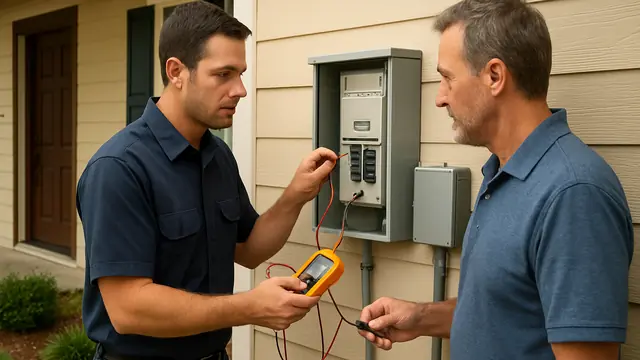
An electrician first identifies whether the issue is limited to one device, one branch circuit, or the entire system. The technician may operate the appliance that triggers the flicker while measuring voltage and current.
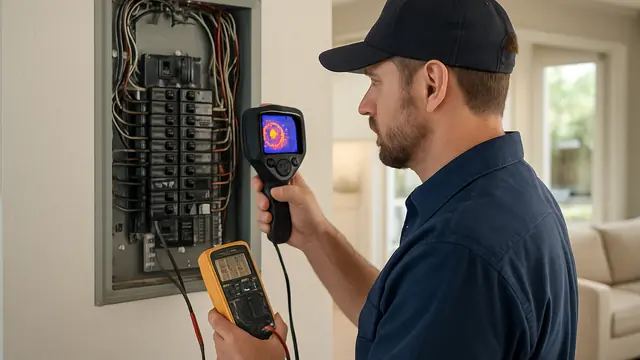
The inspection can include the bulb, socket, switch, dimmer, fixture wiring, junction boxes, breaker, neutral bar, panel connections, and service equipment. Thermal testing may reveal a connection heating under load.
If incoming voltage is unstable, the electrician may document it and coordinate with the utility provider. A systematic diagnosis prevents unnecessary replacement.
Repair Options, Starting With the Least Invasive
- The simplest solution may be installing a compatible bulb. An incompatible dimmer can often be replaced with an LED-rated control.
- A worn switch, damaged socket, or loose fixture connection may be repaired or replaced. An accessible loose splice can be re-terminated after heat-damaged material is removed.
- If the circuit is overloaded, an electrician may redistribute loads, install a dedicated circuit, or correct an improper shared load. A failing appliance may need service.
A defective breaker or damaged panel connection can sometimes be replaced. Feeder, neutral, panel, or service replacement is reserved for conditions where testing shows a localized repair is unsafe or insufficient.
Factors That Affect the Cost
Cost depends on where the fault is located and how difficult it is to reproduce. A constantly flickering bulb is easier to diagnose than an intermittent connection hidden in a wall or ceiling.
Fixture access, dimmer type, integrated LED components, concealed wiring, panel condition, dedicated-circuit needs, permits, and utility coordination can also affect the scope.
Accurate diagnosis matters. Replacing fixtures will not solve a loose neutral or service problem.
Prevention and Maintenance
Use bulbs that match the fixture label and dimmer compatibility information. Avoid operating several high-wattage portable appliances on one circuit.
Have major appliances evaluated for proper circuit requirements. Keep the panel directory accurate, and schedule service for buzzing, warmth, repeated trips, or recurring voltage changes.
In a part-time or rental property, ask guests, cleaners, or property managers to record the room, time, appliance use, and breaker activity when flickering occurs.
Take the Next Safe Step
If you are asking, "Why are my lights flickering in Camp Creek?" determine whether the symptom affects one fixture, one circuit, or the entire property. A defective bulb may be simple, but repeated flickering, unusual brightness changes, heat, odor, noise, or breaker activity should not be ignored. A licensed electrician can find the source and recommend the least invasive safe repair.
About this guide: This resource provides general homeowner education, not a remote diagnosis. Actual conditions, code requirements, equipment, and safe repair options must be evaluated at the property.