Stop and call for qualified help when plumbing water is near electrical equipment, sewage is entering occupied space, gas or burning odors are present, or a repair would require opening pressurized piping.
A hot-water problem can disrupt an entire household quickly. You may notice that the primary shower takes longer to warm up, a guest bathroom never gets fully hot, or the heater begins clicking, shutting down, or leaking just before family or visitors arrive. For an Alys Beach homeowner, the practical question is whether to repair or replace a water heater before another interruption.
Begin by checking for an active leak without touching wet electrical equipment or hot piping. If water is escaping rapidly, close the cold-water shutoff valve to the heater if it is accessible and safe. For an electric system, turn off the dedicated breaker only when the surrounding area is dry. If you smell gas near a gas-fired heater, leave the area and contact the gas utility or emergency services as appropriate.
Identify the Type of Failure
A heater that produces no hot water may have an electrical, ignition, control, fuel-supply, or internal component failure.
A system that produces hot water but not enough of it may have a failed lower heating element, thermostat issue, sediment accumulation, dip-tube problem, slow recovery, or insufficient capacity for current demand.
Water that is too hot may indicate a thermostat or control failure. Temperature fluctuations can also result from a mixing valve, crossed plumbing connection, scale in a tankless heater, or a fixture-specific problem.
Noise provides another clue. Popping and rumbling often indicate sediment in a storage tank. Repeated ignition attempts, unusual vibration, or new mechanical sounds deserve evaluation.
Water around the unit may originate from a threaded connection, isolation valve, drain valve, relief valve, condensate line, circulation component, or the tank itself.
Repair or Replace a Water Heater in Alys Beach: A Practical Framework
First, determine whether the tank or heat exchanger is structurally intact. A conventional tank leaking through its steel shell normally requires replacement because the pressure vessel has failed.
Next, ask whether the failed component is isolated. A thermostat, element, igniter, valve, sensor, or connector can often be replaced without replacing the whole system.
Reliability also matters. Several service calls in a short period may indicate a cycle of aging components. Even when each repair is technically possible, continued investment may not be economical.
Performance is another factor. If the current heater cannot support simultaneous showers, laundry, dishwashing, or guest use, repair may restore operation without correcting inadequate capacity.
Corroded connections, poor drainage, inadequate service clearance, venting concerns, outdated valves, high water pressure, or failed expansion control may influence the recommendation.
Safe Checks Before Scheduling Service
- Confirm whether every hot-water outlet is affected. A single shower with unstable temperature may have a cartridge or mixing-valve problem rather than a heater failure.
- Check the unit's display for an error code and take a photo.
- Look for a tripped breaker on an electric heater. Reset it only once and only when there is no moisture, burning odor, buzzing, or visible damage. If it trips again, leave it off.
Inspect the drain pan and nearby floor. Note whether water is clear or rusty, warm or cool, continuous or occasional, and whether it appears at a connection, valve, pipe, or bottom seam.
Repairs Homeowners Should Not Attempt
- Do not bypass a thermostat, high-limit switch, flame sensor, pressure switch, or other safety control. These parts shut the heater down when operating conditions become unsafe.
- Never plug, cap, or tie off the temperature-and-pressure relief valve. It protects the tank from excessive pressure and temperature.
- Do not alter gas piping, burners, or venting. A heater that lights is not necessarily operating safely.
- Do not remove electrical covers to test components unless you are trained and equipped for high-voltage work.
- Do not use sealant as a permanent fix for a leaking tank. Surface patching does not restore the integrity of a pressurized vessel.
When the Situation Is Urgent
- An active tank leak is urgent because it can release a large volume of water and damage flooring, walls, cabinetry, ceilings, or equipment below.
- Repeated breaker trips, scorched wiring, melted insulation, or a burning smell require immediate shutdown and professional service.
- For a gas system, gas odor, soot, delayed ignition, unusual flame behavior, or signs that exhaust is not venting correctly should be treated seriously.
- Water that suddenly becomes dangerously hot can cause burns. Stop using affected fixtures until the controls are inspected.
- A relief valve that discharges continuously may be reacting to excess temperature, excess pressure, or failed thermal-expansion control and should be diagnosed promptly.
How a Licensed Plumber Determines the Best Option
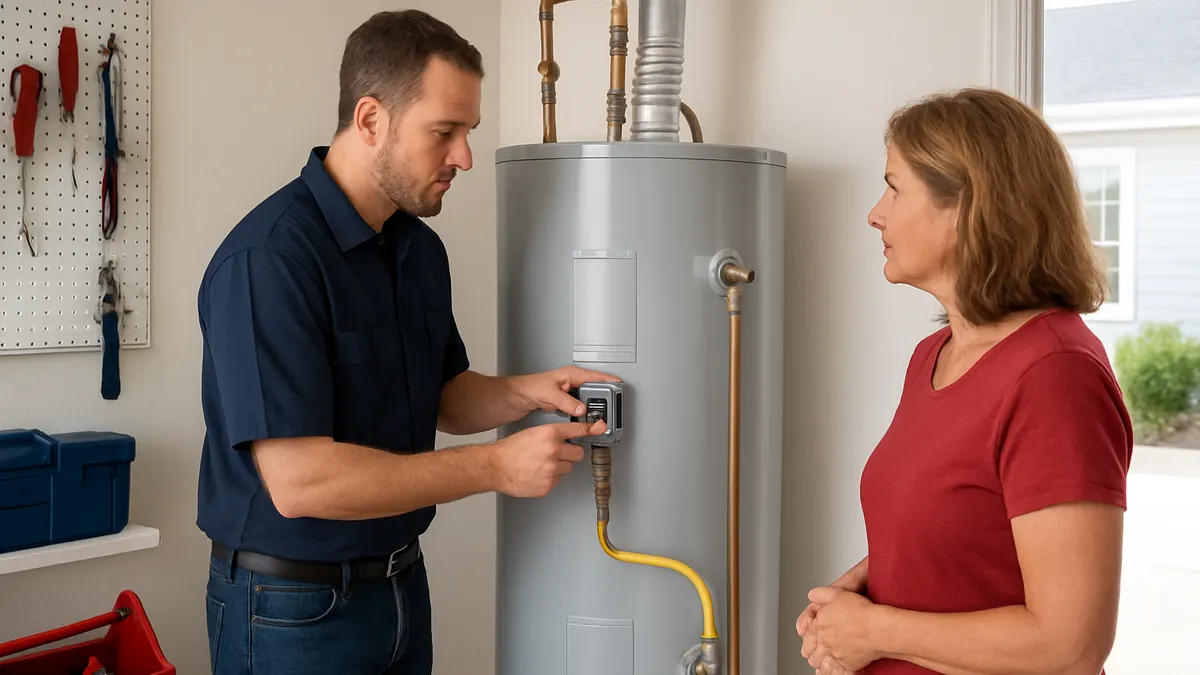
Diagnosis begins with when the problem started, whether it is constant or intermittent, which fixtures are affected, and whether the heater has been repaired before.
The plumber identifies the model, fuel type, capacity, installation condition, and approximate age. This helps determine testing procedures and parts availability.
On an electric tank, testing may include incoming power, thermostats, heating elements, wiring, and high-limit controls. On a gas tank, diagnosis may include ignition sequence, burner operation, safety controls, gas supply, combustion, and venting.
On a tankless unit, the plumber may inspect flow rate, filters, scale accumulation, sensors, fuel or electrical input, venting, condensate drainage, and stored error history.
Least-Invasive Repair Options
- The simplest repair may be replacing a flexible connector, tightening a threaded fitting, installing a shutoff valve, or correcting a drain or condensate line.
- A storage heater may need a thermostat, heating element, anode rod, drain valve, relief valve, ignition component, burner service, or gas control.
- A tankless heater may need filter cleaning, descaling, sensor replacement, ignition service, condensate correction, or a circulation adjustment.
- Sediment or scale may sometimes be addressed through proper maintenance when the equipment is otherwise sound. Maintenance cannot repair a cracked, corroded, or leaking vessel.
Replacement becomes the better choice when the tank or heat exchanger has failed, corrosion is widespread, major components are unavailable, capacity is inadequate, or the system has become unreliable.
Factors That Affect Cost
Repair cost varies with the failed part, model, fuel type, accessibility, diagnostic time, and whether the failure affected nearby components.
Replacement cost depends on heater type, capacity, efficiency, installation location, removal access, piping changes, electrical load, gas supply, venting, condensate drainage, recirculation, drain protection, and required safety upgrades.
Maintenance That Helps Prevent Premature Failure
Inspect the area around the heater for rust streaks, damp fittings, mineral deposits, or staining. Small changes can reveal a slow leak.
Follow manufacturer recommendations for tank flushing, anode-rod inspection, tankless descaling, and filter cleaning. Maintenance frequency depends on the equipment and operating conditions.
Have water pressure and expansion control checked when relief valves discharge or connections fail repeatedly.
Reassess hot-water demand when household use changes. More simultaneous use may require capacity or recirculation adjustments rather than repeated service calls.
Choose the Option That Solves the Actual Problem
The decision to repair or replace a water heater in Alys Beach should be based on a complete diagnosis, not age alone. A sound system with one failed part may have useful service life remaining. A leaking, corroded, undersized, or repeatedly failing system may be better replaced before another interruption or water-damage event.
About this guide: This resource provides general homeowner education, not a remote diagnosis. Actual conditions, code requirements, equipment, and safe repair options must be evaluated at the property.