In Latitude Margaritaville Watersound, ceiling fans do more than keep a room comfortable. They help move air in homes that deal with humidity, salt air, strong storms, and long cooling seasons. When a fan starts wobbling, humming, or tripping a breaker, it is not just an annoyance. It can point to a wiring issue, a loose mounting box, or a circuit that is carrying more than it should.
For homeowners in Bay County, fan service is part of a bigger electrical picture. Safe ceiling fan installation and repair can protect your wiring, reduce strain on switches and circuits, and make sure your home is ready for coastal weather. If you are looking for ceiling fan installation and repair in Latitude Margaritaville Watersound, it helps to understand what a proper installation includes and which warning signs should never be ignored.
Homes in this area include newer builds, remodels, and additions, and each one can have different electrical needs. Some fans are installed over living rooms with vaulted ceilings. Others are added during a renovation when lighting, switches, or wiring need to be updated too. In every case, the fan should be matched to the box, the circuit, and the room size. That is especially important in a coastal community where vibration, moisture, and storm related power issues can shorten the life of electrical components.
Why ceiling fan work matters more in a coastal community
Salt air and humidity can affect metal parts, fasteners, and electrical connections over time. In a place like Latitude Margaritaville Watersound, even a fan that looked fine a year ago may start to show wear sooner than expected. A loose blade, noisy motor, or flickering light kit may seem minor, but these issues can create heat at the connection points or stress the ceiling box.
Storm season adds another layer of concern. Power surges, brief outages, and repeated shutoffs can affect fan controls, wall switches, and integrated lighting. If your home also has newer loads like EV charging, a generator, or upgraded lighting, the electrical system has to keep up. That is why local electrical service matters. A licensed electrician understands how to evaluate the fan, the circuit, the breaker, and the rest of the home’s electrical system together.
If you are comparing options from an electrician in Latitude Margaritaville Watersound, look for a team that can handle more than the fan itself. Ceiling fan work often overlaps with switch repair, outlet repair, lighting installation, wiring repair, and electrical inspections. A good repair visit should leave the installation safer, quieter, and better matched to the room.
What a proper ceiling fan installation includes
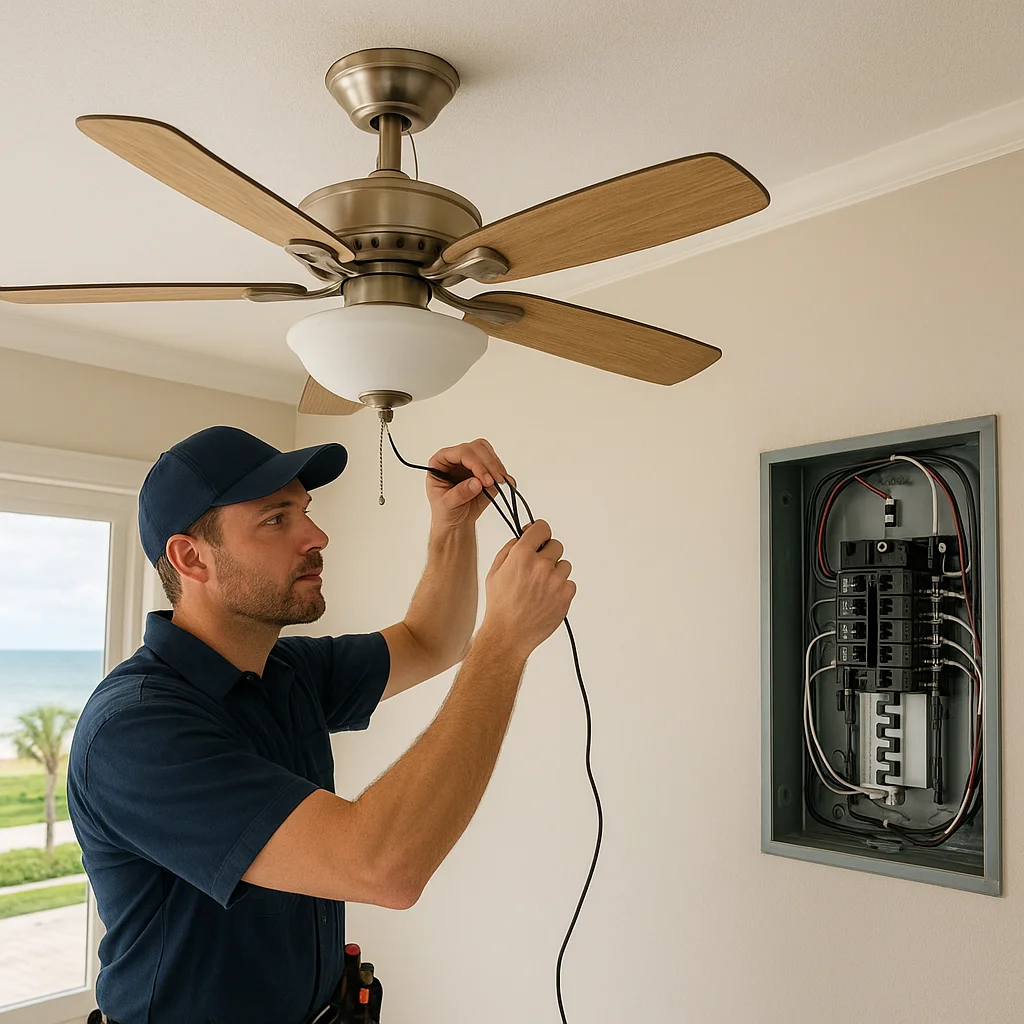
Ceiling fan installation is not the same as hanging a light fixture. Fans create movement and vibration, so the mounting box must be fan rated and firmly secured to framing or an approved support. The wiring must be connected correctly, the blades balanced, and the controls tested under load. If the fan includes a light kit or remote receiver, those parts also need to be installed in a way that does not overheat or interfere with operation.
Key details a licensed electrician checks
A professional installation usually includes checking the ceiling box, verifying the circuit capacity, confirming grounding, and making sure the wall switch and fan controls are compatible. In some homes, the electrician may recommend a dedicated circuit if the room already has heavy lighting or other equipment. In others, the fix may be as simple as replacing a weak box or correcting a loose splice.
This is also the right time to look at nearby electrical items. A fan installation can reveal a switch that is worn, a dimmer that is not rated for a fan, or a ceiling junction that needs code correction. If a homeowner has been searching for electrical repair in Latitude Margaritaville Watersound, a fan issue may be part of the broader problem.
Repair issues homeowners should take seriously
Some ceiling fan problems are simple, but others can signal a safety issue. A fan that shakes at medium speed may need balancing, but it can also mean the mounting hardware is loose. A fan that hums loudly may have an aging motor, a control issue, or a problem with the capacitor. If the light flickers, the switch or wiring may be failing. If the breaker trips, the circuit may be overloaded or there may be a short in the fan or light kit.
These are the kinds of problems that matter in homes with other electrical upgrades. For example, a homeowner planning panel improvements may discover that the existing fan circuit is not ideal for new lighting or multiple ceiling fixtures. A home considering whole home backup planning may also need to think about which fans and lights should stay on during outages.
If your fan problem keeps returning, do not keep resetting the breaker and hoping it goes away. Repeated trips can indicate a wiring fault, damaged switch, or failing motor. That is the point where homeowners searching for same day electrician near me or power outage electrician near me may really need a full diagnostic, not just a quick reset.
How weather and power conditions in Bay County affect ceiling fans
Coastal storms can create short surges, brownouts, and repeated interruptions that wear on electrical equipment. Fan controls and light kits are often sensitive to that kind of stress. In older homes, or in remodels where wiring has been extended, the problem can be worse if the circuit grounding is weak or the connections are loose. That is why electrical inspections are valuable after storms or during seasonal maintenance.
Humidity also matters. Moisture can affect fan motors, especially in rooms close to open porches, sunrooms, or spaces with frequent airflow from doors and windows. If a fan is installed in a location that is not rated for damp conditions, corrosion can appear faster than expected. In some cases, an electrician may recommend a different fixture, a better box, or improved grounding to help the system hold up longer.
Homeowners thinking about comfort upgrades often start with fans, then move to lighting, surge protection, or generator planning. If your home is already seeing more demand from appliances, charging equipment, or added living space, it may be worth reviewing the panel and branch circuits too. That is especially true for homeowners searching for Bay County electrical service that can handle both comfort and storm readiness.
Signs the fan problem may involve wiring or the circuit
A few symptoms deserve prompt attention. If the fan only works on certain speeds, the control may be failing. If the fan light dims when another appliance starts, the circuit may be overloaded or the wiring may be loose. If you hear crackling at the switch, smell burning, or see discoloration around the canopy, shut the fan off and call a professional. Those are not normal wear issues.
In some homes, the real issue is not the fan at all. The ceiling box may not be rated for fan support. The switch may be an older style that is not compatible with the motor. The breaker may be undersized or weak. Or the wiring feeding the room may need repair. Homeowners searching for flickering lights repair near me or switch repair near me often discover the issue is tied to the same branch circuit that serves the ceiling fan.
Ceiling fans and the rest of the home electrical system
Ceiling fan installation is often a good time to review other electrical needs. If you are adding new lighting, upgrading a bathroom, finishing an addition, or replacing older fixtures, a licensed electrician can help keep the work coordinated. That may include recessed lighting installation, outlet repair, new dedicated circuits, GFCI protection in moisture prone areas, or code corrections for older wiring.
Some homeowners also use that visit to ask about smoke detector installation, surge protection, or generator transfer switch installation. If the home has a service mast issue, grounding concern, or panel that is nearing capacity, those items should be addressed before more loads are added. For larger upgrades, it can help to review practical electrical upgrades that start with the panel and then decide whether the fan work should be bundled with the larger project.
If you have been searching for electrician near me or licensed electrician near me, it is usually a sign the issue has moved beyond a simple DIY fix. Ceiling fans involve support, wiring, and sometimes control compatibility, so the safest route is to have the system checked by a professional who works with local code requirements.
Storm readiness starts with the small electrical details
People often think about generators and panels when they prepare for storms, but ceiling fans and lighting matter too. During an outage, a properly wired fan and light can help a home stay usable when power returns. If your household is planning backup power, it may be time to look at power backup generators and the transfer equipment needed to run selected circuits safely.
Storm readiness also means checking the little parts that keep a home safe every day. That includes smoke detectors, carbon monoxide alarms, GFCI outlets, grounded circuits, and secure fan mounts. If your ceiling fan repair turns into a broader safety review, that is a good thing. It means the electrical system is being looked at as a whole instead of one fixture at a time.
For homeowners who want to spread out the cost of upgrades, there are also options that may help with larger projects. If the fan repair is part of a broader electrical improvement plan, electrical financing can make it easier to address repairs without delaying important safety work.
Why local service makes a difference
A home in Latitude Margaritaville Watersound is not the same as a home inland. Coastal weather, salt exposure, storm risk, and local building practices all affect how ceiling fans and electrical systems age. A local electrician understands those conditions and knows how to spot the difference between normal wear and a problem that needs immediate attention. That is especially important in Bay County, where storm season can turn a small electrical issue into a bigger outage or safety concern.
Whether you need a new fan installed, a noisy fan repaired, or a ceiling box evaluated before a remodel, the goal is the same: safe, code compliant work that fits the home and the way it is used. A Superior Mechanical provides ceiling fan installation and repair with that bigger picture in mind, along with related electrical support when the job calls for it. If the project also touches old wiring replacement near me concerns, generator transfer switch installation near me planning, or an electrical panel upgrade near me search, those issues should be handled before the new fan goes up.
For homeowners in Latitude Margaritaville Watersound, ceiling fan service is not just about comfort. It is part of keeping the home ready for daily use, seasonal weather, and the electrical demands that come with modern coastal living.
Find Ceiling Fan Installation & Repair in Latitude Margaritaville Watersound, FL
If you need Ceiling Fan Installation & Repair in Latitude Margaritaville Watersound, FL, visit our local service page or contact A Superior Mechanical today.
Map of Latitude Margaritaville Watersound, FL
Frequently Asked Questions
Can a ceiling fan be installed on any ceiling box?
No. Ceiling fans need a fan rated box that is securely mounted to framing or an approved support. A standard light fixture box may not be safe for fan vibration and weight.
Why does my ceiling fan wobble or make noise?
Wobbling can come from unbalanced blades, loose hardware, or a weak mounting box. Noise may point to motor wear, a control issue, or loose electrical connections.
Should I have an electrician check the wiring before replacing a fan?
Yes, especially in coastal homes or older remodels. A licensed electrician can verify grounding, circuit capacity, switch compatibility, and whether the ceiling box is rated for the new fan.
Can ceiling fan problems be related to breaker trips or flickering lights?
They can. Shared circuits, loose wiring, failing switches, or an overloaded branch circuit can cause breaker trips, light flicker, or intermittent fan operation.
Related Articles
- Smart Electrical Planning for Whole Home Backup in Latitude Margaritaville Watersound
- Practical Electrical Upgrades That Start with the Panel in Latitude Margaritaville Watersound
- Keeping Coastal Homes Comfortable Starts with Better Ductwork in Latitude Margaritaville Watersound
- Better Waterline Replacement Care for Reliable Homes in Latitude Margaritaville Watersound, FL
Photo Gallery