Do not remove an electrical panel cover, touch exposed conductors, bypass protection, or repeatedly reset a fault. Keep clear of smoke, sparks, burning odors, hot equipment, standing water near electricity, and downed lines, then call qualified help.
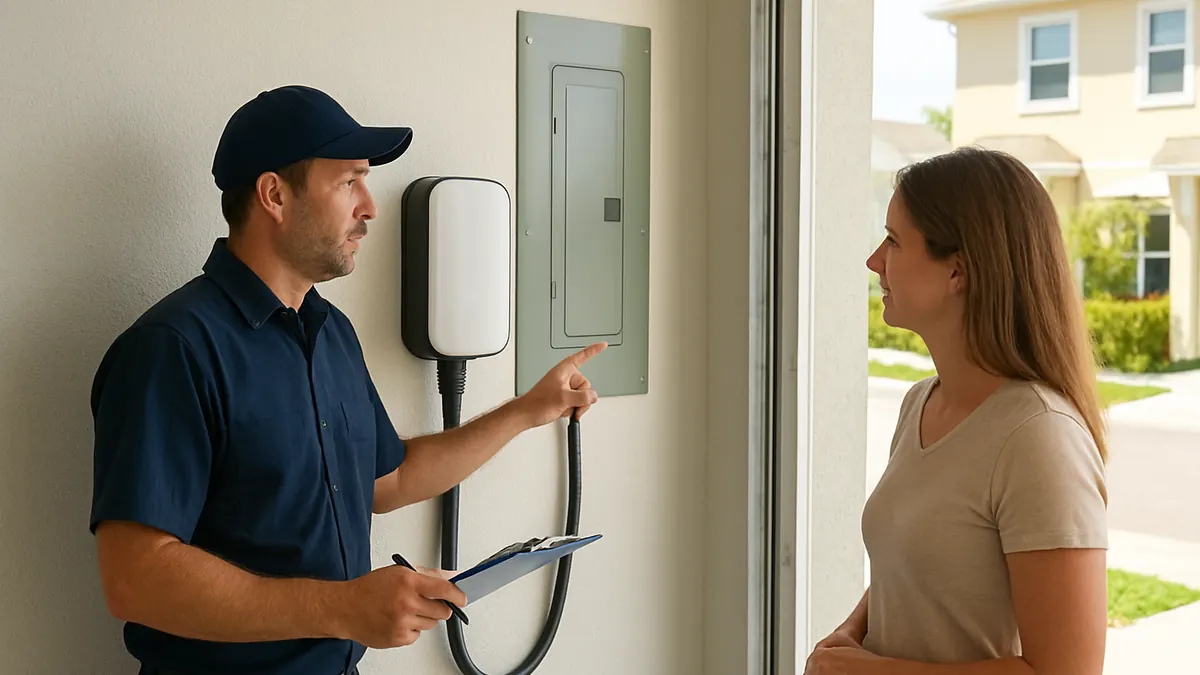
Your new EV charges from a regular wall outlet, but after a full night it still has not recovered the range you used the day before. You want a Level 2 charger, yet the main breaker is labeled 100 or 150 amps, the directory has handwritten changes, or the garage is separated from the house. It is reasonable to ask whether the electrical system can support faster charging before buying equipment or opening walls.
Continue using only the manufacturer-approved charging cord in a sound outlet, and stop if the outlet, plug, or cord becomes hot. Do not test an unidentified 240-volt receptacle, change breakers, or run an extension cord to the vehicle. A licensed electrician should inspect the service and complete a load calculation first.
Residential Level 2 charging generally uses 240 volts. The panel must have physical room for the required breaker and enough electrical capacity for the charger in addition to existing loads. Those are separate questions.
What the Panel Size Really Tells You
The main-breaker rating identifies an important limit, but not the whole story. Two homes with the same service size can have very different available capacity.
One may use gas for cooking and water heating and have modest electrical demand. Another may have electric heat, multiple cooling systems, an electric water heater, range, dryer, pumps, workshop equipment, or other large loads.
A 100-amp panel does not automatically mean "no," and a 200-amp panel does not automatically mean "yes." A lower charging rate or approved energy management may provide a practical solution without a full service upgrade.
Common Obstacles to a Level 2 Charger
Limited Service Capacity
The load calculation may show that a high-output charger would push the home beyond available demand, especially when major electric appliances may operate together.
A Full or Incorrectly Modified Panel
A Level 2 circuit generally needs a two-pole breaker. A panel may have capacity but no approved spaces. Previous additions may also have introduced incorrect breakers, overcrowding, or poor labeling.
An Unsuitable Existing 240-Volt Circuit
A garage or workshop receptacle may have served a welder, dryer, compressor, or other equipment. The outlet shape does not prove that the wiring, breaker, grounding, or condition is appropriate for EV charging.
A Long Route to the Vehicle
A detached garage, carport, or distant parking space can require longer conductors, conduit, trenching, weather-resistant equipment, or physical protection.
Equipment Defects
Corrosion, loose connections, overheating, damaged insulation, or water entry must be addressed before adding a sustained charging load.
Warning Signs That Should Be Addressed First
Repeated breaker trips are not a reason to install a larger breaker. They may indicate an overload, loose connection, damaged equipment, wiring fault, or failing breaker.
Stop charging if the receptacle, connector, cable, breaker, or charger becomes hot. Burning odor, buzzing, crackling, discoloration, melted plastic, sparks, or error messages also require attention.
Have the panel examined promptly if lights flicker when charging begins, the main breaker trips, the enclosure feels warm, or you see corrosion or moisture. For smoke, fire, or active arcing, keep away and call emergency services.
Safe Checks a Homeowner Can Perform
Photograph the closed panel, its label, main breaker, directory, and any existing outlet you hope to use.
Record the EV and charger model numbers. Find the installation manual and note the maximum output, lower settings, plug configuration, and hardwiring requirements.
List major electric equipment, including HVAC units, electric heat, water heater, cooking equipment, dryer, pumps, pool equipment, and workshop loads. Include planned additions such as a second EV.
Track your daily driving. If the vehicle typically sits for ten or twelve hours, a moderate setting may be enough even when the charger can operate at a higher maximum.
What You Should Not Attempt
- Do not remove the panel cover or meter enclosure. Turning off the main breaker does not necessarily de-energize every component inside the service equipment.
- Do not install a larger main breaker, substitute a different breaker brand, double wires under a terminal, or add tandem breakers unless the panel design specifically permits it.
- Do not open an existing receptacle, use a splitter or homemade adapter, or route a temporary cable through doors or windows.
- Do not raise the charger's current setting after installation because charging seems slow. A higher setting can exceed the circuit or service design.
How a Licensed Electrician Determines Capacity
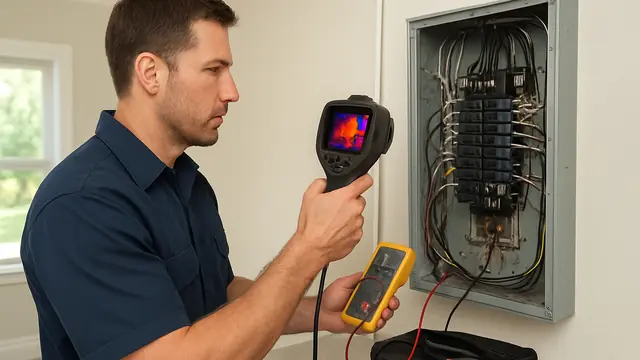
The inspection covers the service rating, panel rating, main breaker, circuit positions, breaker compatibility, grounding and bonding, and overall condition. The electrician checks for heat damage, corrosion, loose terminations, improper modifications, and conductor sizes.
A load calculation then evaluates the applicable household demand and proposed EV load. Adding the breaker numbers would produce a misleading result. The National Electrical Code establishes safety requirements for electrical installations, including EV charging equipment and supporting circuits.
The electrician also measures the route and determines conductor size, wiring method, voltage-drop considerations, mounting, weather protection, and whether hardwiring or a listed receptacle is appropriate.
Repair and Installation Options
The least invasive option may be a dedicated circuit with the charger commissioned at a lower amperage. The goal is to restore your normal daily range, not necessarily to use maximum output.
If the service has capacity but the panel lacks spaces, an approved reconfiguration or subpanel may solve the space problem. A subpanel does not increase service capacity.
An approved load-management system may allow charging to slow or pause when household demand is high. This can use available capacity more efficiently and may avoid larger infrastructure work.
Panel replacement may be recommended when equipment is damaged, overcrowded, incompatible, or unsuitable for needed components. A service upgrade becomes appropriate when the calculation shows inadequate capacity and lesser options cannot meet the required charging performance.
Typical Factors That Affect Cost
Charger output influences breaker and conductor size. Other factors include panel condition, breaker availability, circuit length, wall or ceiling access, conduit, trenching, detached structures, outdoor exposure, mounting, permits, inspections, and utility coordination.
Existing repairs, a subpanel, load management, panel replacement, or a service upgrade can change the scope. Future preparation for a second EV may also affect equipment choices.
Ask for a written scope identifying the charging rate, circuit rating, included equipment, required repairs, and optional upgrades.
Prevention and Maintenance
Use the charger only at the approved setting. Keep the cable supported and away from tires, sharp edges, standing water, and closing doors.
Inspect the connector, cord, receptacle if present, and charger enclosure for cracking, looseness, rust, discoloration, or heat marks. Stop using the equipment if the breaker trips or charging faults become frequent.
Schedule another capacity review before adding a second charger or another major electrical load.
Can Your Electrical Panel Support a Level 2 EV Charger in DeFuniak Springs?
The panel may support useful Level 2 charging even if it is smaller or appears full. The answer may involve a lower setting, dedicated circuit, load management, subpanel, panel repairs, or service upgrade.
Do not decide from the main-breaker label or an existing outlet alone. A complete inspection and load calculation identify the safest, least invasive option that meets your driving needs.
About this guide: This resource provides general homeowner education, not a remote diagnosis. Actual conditions, code requirements, equipment, and safe repair options must be evaluated at the property.