Stop and call for qualified help when plumbing water is near electrical equipment, sewage is entering occupied space, gas or burning odors are present, or a repair would require opening pressurized piping.
You return to a Laguna Beach property after time away and notice several things: stale-tasting water at the kitchen sink, white residue on the shower glass, and dark specks from one bathroom faucet. These symptoms may look connected, but they can come from different sources.
The safe immediate step is to flush each cold-water fixture briefly, compare hot and cold water, and note whether the issue is isolated or house-wide. Do not drink water with a sudden unusual odor, color, or oily appearance. Do not assume coastal air determines indoor water hardness, and do not purchase treatment equipment until testing shows what the water needs.
Why Water Softeners and Whole-House Filters Are Confused
Both systems may be installed on the main water line, but their jobs are different.
A water softener reduces hardness minerals through ion exchange. Hardness minerals are dissolved, so ordinary sediment and carbon filters do not capture them. A softener is intended to reduce scale, soap scum, spotting, and mineral buildup in water-using equipment.
A whole-house filter uses media selected for another target. Sediment cartridges capture particles. Activated carbon may reduce certain tastes and odors. Specialty media can address other verified conditions.
Neither system is automatically better. The correct choice depends on symptoms, test results, water use, maintenance expectations, and plumbing layout.
Separate Scale From Taste and Debris
Scale-Related Complaints
White crust around showerheads, chalky film on fixtures, poor soap performance, and repeated mineral buildup can justify testing for hardness. These symptoms usually develop gradually and appear at multiple fixtures.
A softener may reduce future scale, but it will not remove old deposits already bonded to glass, valves, or heating elements. Existing scale may require cleaning or appliance service.
Taste and Odor Complaints
A consistent taste or odor from cold water may lead to evaluation of activated-carbon filtration. If the condition appears only after the home has been unused, stagnant water in interior plumbing may contribute. Flushing can show whether it clears, but persistent or strong odors require investigation.
Specks, Flakes, and Particles
Dark specks at one faucet may come from the aerator, a flexible connector, or deteriorating rubber. White flakes on the hot side may come from the water heater. Rust-colored debris may originate from a plumbing component.
A whole-house sediment filter may help when particles enter through the main supply, but it cannot stop material released downstream by a fixture or water heater.
Safe Checks for the Property
Use a clear glass to compare water from cold fixtures near and far from the main entry point. Differences may show whether the problem develops inside the home. Inspect an aerator for debris only if it can be removed and reinstalled without damage.
- Compare kitchen cold water, bathroom cold water, and hot water. Record exactly where the symptom appears.
- Check the service date on any existing filter. In a property with irregular use, maintenance may be missed, but many filters still have time-based replacement requirements.
- Look around treatment equipment for leaks, salt crust, disconnected drain tubing, error codes, or a moved bypass valve. Do not disassemble the control head or tank.
What These Systems Cannot Fix
A softener is not a disinfecting device and cannot protect against sewage contamination, microorganisms, or an official boil-water notice. It also cannot repair corrosion.
A standard sediment or carbon filter does not remove hardness minerals, so scale can continue even if taste improves.
Neither system can correct low pressure caused by a failing pipe or partially closed valve. An undersized or overdue filter may make pressure worse. Filter media also have specific limits and capacities.
Warning Signs That Need Prompt Attention
Arrange professional evaluation when water suddenly changes throughout the property, especially after plumbing work or a supply interruption. Blue-green, black, brown, pink, or oily-looking water should not be dismissed as a routine filtration issue.
- A sewage, gasoline, solvent, or strong chemical odor is urgent. Stop using the water for drinking and cooking until appropriate guidance is obtained.
- Call promptly if a treatment tank leaks, a drain line runs continuously, the softener repeatedly cycles, the brine tank overflows, or pressure falls sharply.
- When guests report unusual water, document the symptom and avoid declaring it harmless before identification.
What Not to Attempt
- Do not pour pool chemicals, bleach, vinegar, or acid into treatment tanks unless an approved procedure is being performed by a qualified person.
- Do not leave bypass valves partly open. Partial bypass can create confusing water quality and pressure problems.
- Do not install equipment where controls, cartridges, and electrical components lack suitable protection or service access.
- Do not assume a larger system is automatically better. Oversized equipment may regenerate poorly, sit stagnant, or cost more without improving results.
How a Licensed Plumber Finds the Right Solution
The plumber asks when the complaint appears, whether flushing helps, which fixtures are affected, and whether the property has periods of low use.
Testing includes hardness when a softener is considered. Other measurements may include pH, total dissolved solids, chlorine-related indicators, and observations related to staining or sediment. Laboratory testing may be recommended for unusual concerns.
The technician measures pressure, flow, pipe size, and likely simultaneous fixture use. Existing equipment is checked for programming, media condition, bypass position, drain flow, leaks, and pressure loss. The water heater and fixtures are inspected when symptoms suggest a downstream source.
Treatment Options From Least to Most Invasive
The first option may be flushing stagnant lines, replacing an aerator, changing a damaged supply connector, or servicing a water heater. These repairs may solve problems that whole-house equipment cannot.
For taste at one sink, a point-of-use carbon filter or reverse-osmosis system may be appropriate.
For incoming particles, a sediment filter can be installed ahead of other equipment. Cartridge size and micron rating must balance particle capture with adequate flow.
For whole-property taste and odor, carbon filtration may be installed on the main line. Cartridge systems are simple, while backwashing tanks offer different capacity and maintenance characteristics.
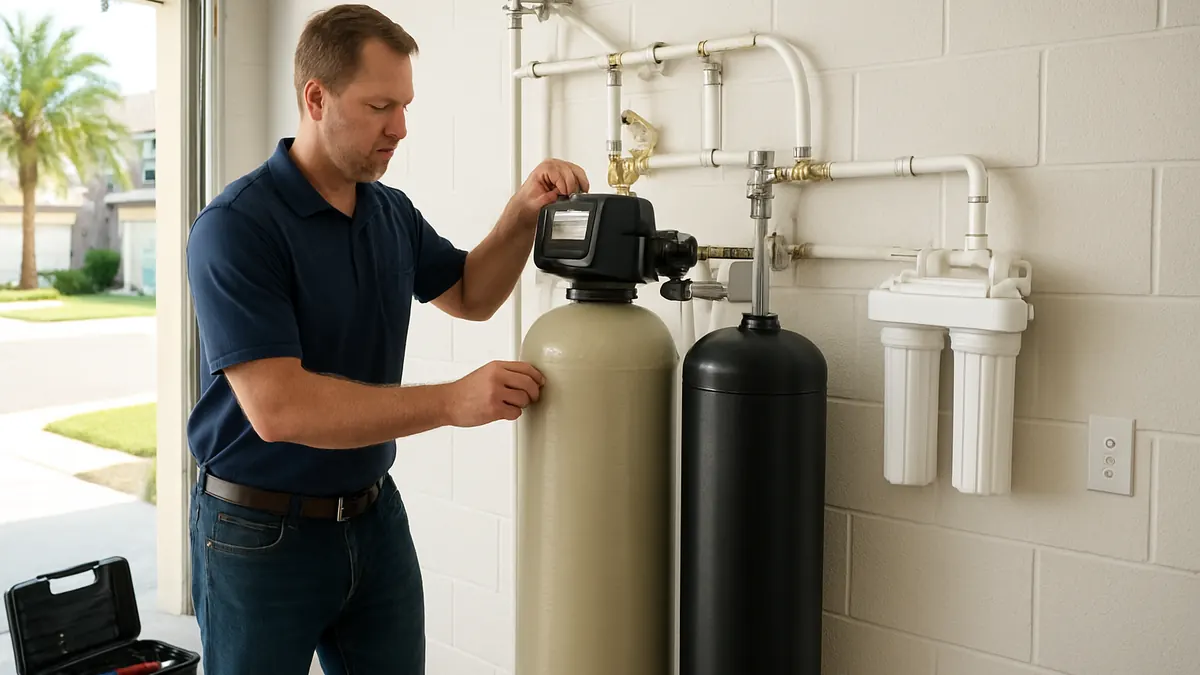
For confirmed hardness, a conventional softener can reduce scale formation. When hardness and filtration concerns are both present, separate stages may provide clearer performance and easier service than an all-purpose claim.
Existing equipment may only require cleaning, programming, seals, valve service, or new media. Replacement should follow diagnosis.
What Affects Cost
Cost is influenced by capacity, media type, flow rating, treatment stages, pipe size, warranty, main-line access, drainage, electrical service, available space, and existing shutoffs.
Long-term costs include cartridges, salt, regeneration water, replacement media, sanitizing, and periodic service. Remote leak protection may be useful for a property that is not checked daily.
Prevention and Maintenance
Keep a log of cartridge changes, salt additions, test results, repairs, and times the system was bypassed.
After a vacancy, flush fixtures and inspect equipment for leaks before use resumes.
Use manufacturer-recommended salt, watch for salt bridging, and replace filters before severe pressure loss occurs. Retest the water when taste, odor, spotting, or flow changes noticeably.
Water Softener Versus Whole-House Filtration in Laguna Beach: Decide From Evidence
Choose a softener for confirmed hardness and scale concerns. Choose filtration for a verified taste, odor, or particle problem. Choose plumbing repair when the source is a fixture, connector, pipe, or water heater. When several symptoms appear together, staged testing prevents an expensive wrong answer.
About this guide: This resource provides general homeowner education, not a remote diagnosis. Actual conditions, code requirements, equipment, and safe repair options must be evaluated at the property.