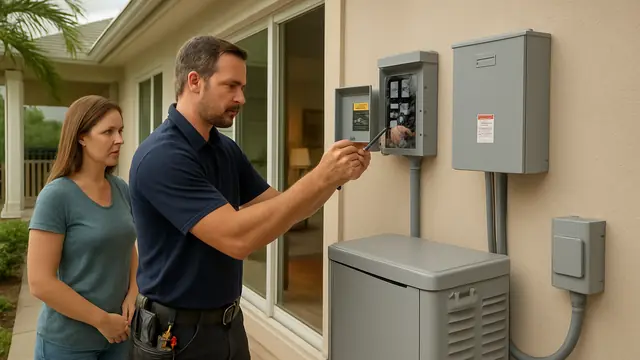
Do not remove an electrical panel cover, touch exposed conductors, bypass protection, or repeatedly reset a fault. Keep clear of smoke, sparks, burning odors, hot equipment, standing water near electricity, and downed lines, then call qualified help.
The utility power fails, your existing generator starts, and the house seems normal until the second air conditioner or electric water heater turns on. Lights dim sharply, the generator labors, and a breaker trips. The safe response is to switch off nonessential appliances using their normal controls and let the generator stabilize. Do not repeatedly reset breakers, open the transfer switch, or try to increase the generator's output yourself.
What size standby generator does your home need in Lower Grand Lagoon? The correct size is the capacity required to run selected household loads while also starting the largest motors. The answer changes depending on whether the property is occupied full time, used seasonally, or expected to support guests. The electrical equipment-not square footage alone-determines the result.
Why "Whole-Home Generator" Can Be Misleading
Homeowners often hear "whole-home" and assume every appliance can operate simultaneously. In practice, a whole-home standby system may supply the main panel while using load-management controls to prevent several large appliances from operating together.
Load management is automatic prioritization. When demand approaches the generator's limit, a control temporarily disconnects a lower-priority load, such as an electric water heater, pool pump, second HVAC system, or EV charger. It reconnects that equipment after capacity becomes available.
An essential-load design is different. Only selected circuits receive generator power. These may include refrigeration, lighting, communications, security, receptacles, and one cooling system. Either approach can work when based on a proper calculation.
Major Loads That Determine Generator Size
Central air conditioning
The compressor uses a certain amount of power while running and a larger burst during startup. That surge can cause an undersized or poorly performing generator to stall even when normal running load appears acceptable.
Electric water heating, cooking, and laundry
Water heaters, ranges, ovens, and clothes dryers can consume substantial capacity. A water heater may cycle on after showers while the air conditioner and refrigerator are already operating.
Pumps and outdoor equipment
Pool pumps, drainage pumps, irrigation equipment, and other motors must be identified individually. Both running and starting demand matter.
Electric vehicle charging
EV charging is a large continuous load. It is often assigned low backup priority or excluded unless the system is specifically sized for it.
Safe Information You Can Gather
- Make an outage-use plan. Identify what must stay on for safety, what matters for comfort, and what can wait until utility power returns.
- Photograph visible labels on the outdoor HVAC unit, water heater, range, dryer, pumps, and other fixed equipment. Do not remove service panels to find hidden information.
- Record whether major appliances use gas or electricity. Gas cooking or water heating can reduce electrical demand, while all-electric appliances may increase it.
For an existing generator problem, note the controller message, which appliances were operating, whether the problem occurred immediately after transfer, and whether it began when a compressor or pump started.
What You Should Never Attempt
Never plug a portable generator into a household receptacle to energize the panel. This can backfeed power, bypass safe transfer equipment, and expose workers or occupants to lethal voltage.
Do not replace a generator breaker with a larger one. A tripping breaker may be responding to overload or a fault. Increasing its rating removes protection rather than adding capacity.
Do not bypass a load-control module because it temporarily turns off an appliance. The module may be preventing the entire system from shutting down.
Fuel adjustments, gas-piping changes, transfer-switch repairs, grounding modifications, and internal generator work should be left to qualified professionals.
Portable generators must never operate in an enclosed or partly enclosed location. Carbon monoxide cannot be seen or smelled. Keep working carbon-monoxide alarms in the home and treat every alarm as an emergency.
When Generator Trouble Becomes Urgent
Stop using the equipment and move to a safe location if you smell fuel, see smoke, hear arcing, or observe melted wiring. Call emergency services for fire, a suspected major fuel leak, or a carbon-monoxide alarm.
Anyone experiencing headache, nausea, dizziness, weakness, or confusion during generator operation should move into fresh air and receive emergency assistance.
Electrical service is urgent when the generator repeatedly stalls, produces severe light flicker, cycles power on and off, trips immediately after transfer, or causes appliances to restart continuously. These symptoms may indicate overload, unstable voltage, loose connections, inadequate fuel delivery, or transfer-switch failure.
How a Licensed Electrician Diagnoses the System
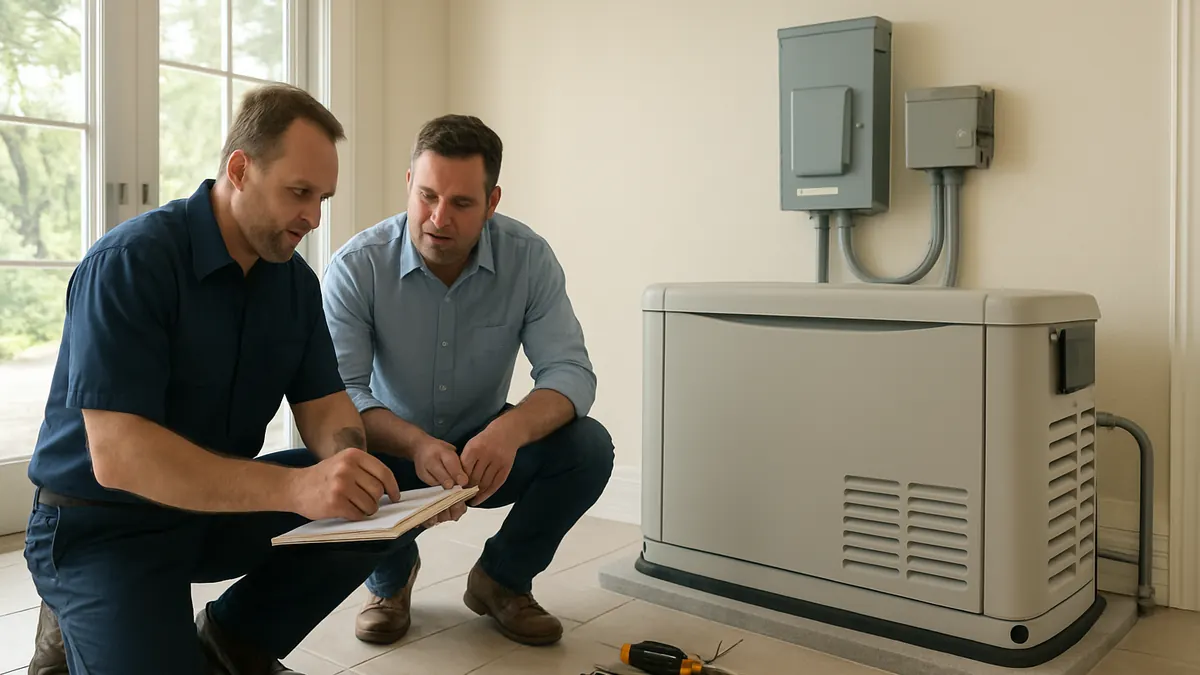
The electrician begins by reviewing the homeowner's required loads rather than assuming every panel circuit needs uninterrupted power. Each major appliance and motor is identified.
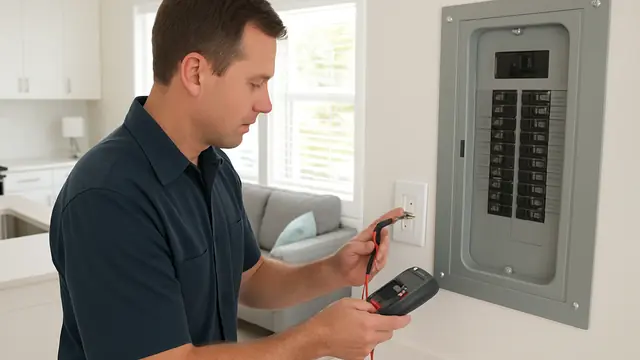
A load calculation estimates normal demand likely to occur at one time. Motor-starting information is reviewed separately because a compressor may require a short surge far above its running current.
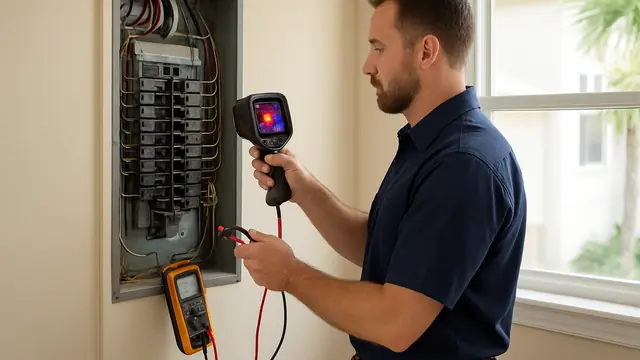
The electrician examines the service, panels, transfer switch, output breaker, grounding and bonding, conductor sizes, and load-shedding modules. Bonding means connecting metal parts together so fault current has a safe path that allows protective devices to operate.
For an existing system, testing may include transfer operation, output voltage and frequency, major-load startup, battery condition, and controller history. Fuel delivery must also be evaluated by an appropriately qualified professional.
Repair Options Before Complete Replacement
The first reasonable option is reducing or reorganizing backup loads. Moving an electric dryer, pool heater, EV charger, or second HVAC system to non-backup operation may correct an overload.
The next option may be installing or reprogramming approved load-management equipment. Proper sequencing can prevent two compressors or other large loads from starting together.
A compatible soft-start device may lower the startup demand of certain air-conditioning systems. The HVAC equipment and generator must be reviewed for compatibility.
If performance has declined, targeted repairs may include battery replacement, tune-up service, fuel-delivery correction, conductor repair, control-board replacement, or transfer-switch service.
Generator replacement is considered when required load exceeds practical capacity after load management, or when the unit is unreliable, obsolete, severely damaged, or no longer supportable.
Factors That Influence Cost
Cost is affected by generator size, transfer-switch type, backed-up circuits, load controls, fuel source, fuel-piping work, panel condition, placement, mounting requirements, trenching, conductor length, permitting, and access.
An existing installation may cost less to correct when the problem is limited to controls or maintenance. Extensive panel work, long fuel or electrical runs, and multiple large loads add complexity.
Preventing Overload and Reliability Problems
Maintain the generator according to the manufacturer's instructions. Service may include oil changes, filters, battery testing, spark plugs where applicable, electrical inspection, and transfer-switch testing.
Keep the enclosure area clear so cooling air can move freely. Report corrosion, damaged wiring, unusual noises, or fluid leaks.
An automatic exercise cycle does not prove the system can carry the home. Periodic professional testing under realistic load can reveal weak batteries, fuel limitations, or control problems before an outage.
Review generator capacity whenever you add or replace a major appliance.
Match the Generator to the Loads That Matter
What size standby generator does your home need in Lower Grand Lagoon? It needs sufficient running capacity, enough motor-starting capability, proper fuel delivery, and a transfer strategy that reflects how the property will be used. A licensed evaluation can determine whether an existing problem requires repair, better load management, or a different generator.
About this guide: This resource provides general homeowner education, not a remote diagnosis. Actual conditions, code requirements, equipment, and safe repair options must be evaluated at the property.